
The AI era is far beyond another algorithm update; it is the beginning of a new search order. With all the new AI tools and platforms emerging, the way users are engaging with the search results is rapidly transforming. The competition for visibility on Google has become more challenging than ever. As part of that transformation, Google has launched an entirely new feature called "AI Overviews", which represents a fundamental shift in how users find and engage with information on web pages.
In this blog, we will outline what AI Overviews are, how they work, and what they mean for your brand visibility. Most importantly, we will give you actionable strategies on how to manage and optimize your content for AI Overviews, as well as ways to maximize your search visibility during a huge transformation in AI search.
What are AI Overviews?
AI Overviews (AIOS) is a new search feature of Google that provides AI-generated answers that appear in the search results. It was previously the Search Generative Experience (SGE). An AI Overview is a brief AI-generated response that summarizes the most relevant and authoritative information to the search query.
These overviews are produced with advanced generative AI, which sources and evaluates the best and most authoritative references to synthesize and give you the highlights in a brief sentence. The AI Overviews also display above traditional organic results, and depending on the type of search (customer intent), they may display before or after any paid ads that also show up for your search.
Google started rolling out AI Overviews in the U.S. in May 2024. From the very start, they appeared on nearly 75% of all queries, which was a huge shift for the search landscape. This means that summaries generated by the AI were showing up on more than 14.2 million queries, often without users actively opting in.
AI Overviews do much more than answer basic queries. The AI can answer more complex, layered queries and provide complex answers, where each AI Overview is treated as one distinct response.
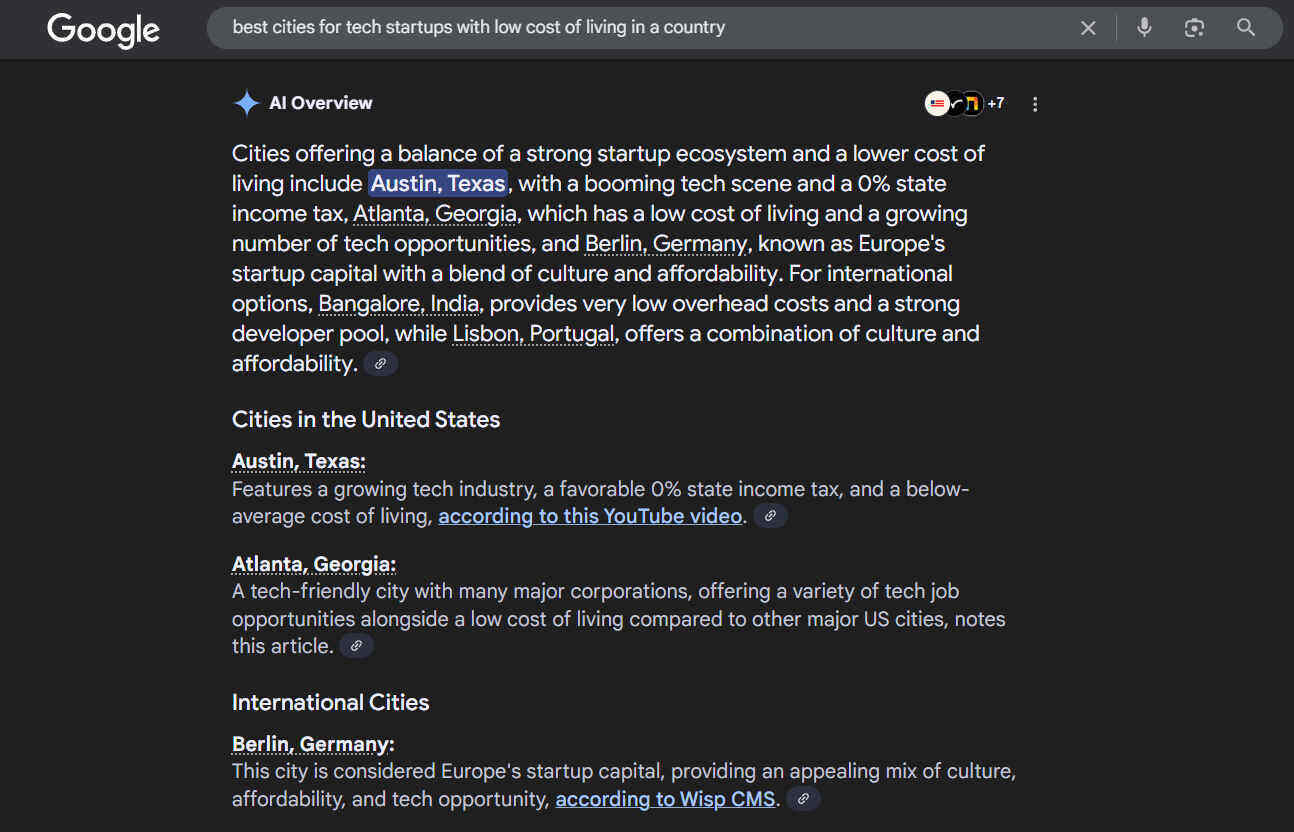
For example, if you searched something like "best cities for tech startups with low cost of living in a country", the AI Overview will evaluate all of the immediate factors and provide the best result:
1. Cities that are good for tech startups
2. Affordability and low cost of living
3. Geographic location constraints or preferences, and
4. Any rankings or comparisons that support suggesting some "best" options
Instead of requiring users to search each aspect individually, AI Overviews synthesizes the information and delivers a complete answer in one go, making the search experience faster, smarter, and more intuitive.
Are AI Overviews accurate?
AI overviews are not hundred percent accurate when it comes to the queries, although they provide informative & reliable AI information in nearly all cases. Google stated there were some strange, inaccurate, or unhelpful AI Overviews that we noticed, typically for queries that people just do not commonly do. These errors, or problems, have highlighted some specific areas Google has to work on.
According to another Google study, the accuracy of AIO data is comparable to that of highlighted snippets, which typically have a very high degree of trust in the information. In a survey completed for 2022, only 12.5% of all highlighted snippets were not considered trustworthy.
Furthermore, it is important to remember that AIOs are content created from previously existing materials, which could have incorrect information, so you cannot always trust that it is correct.
How does AI Overviews work?
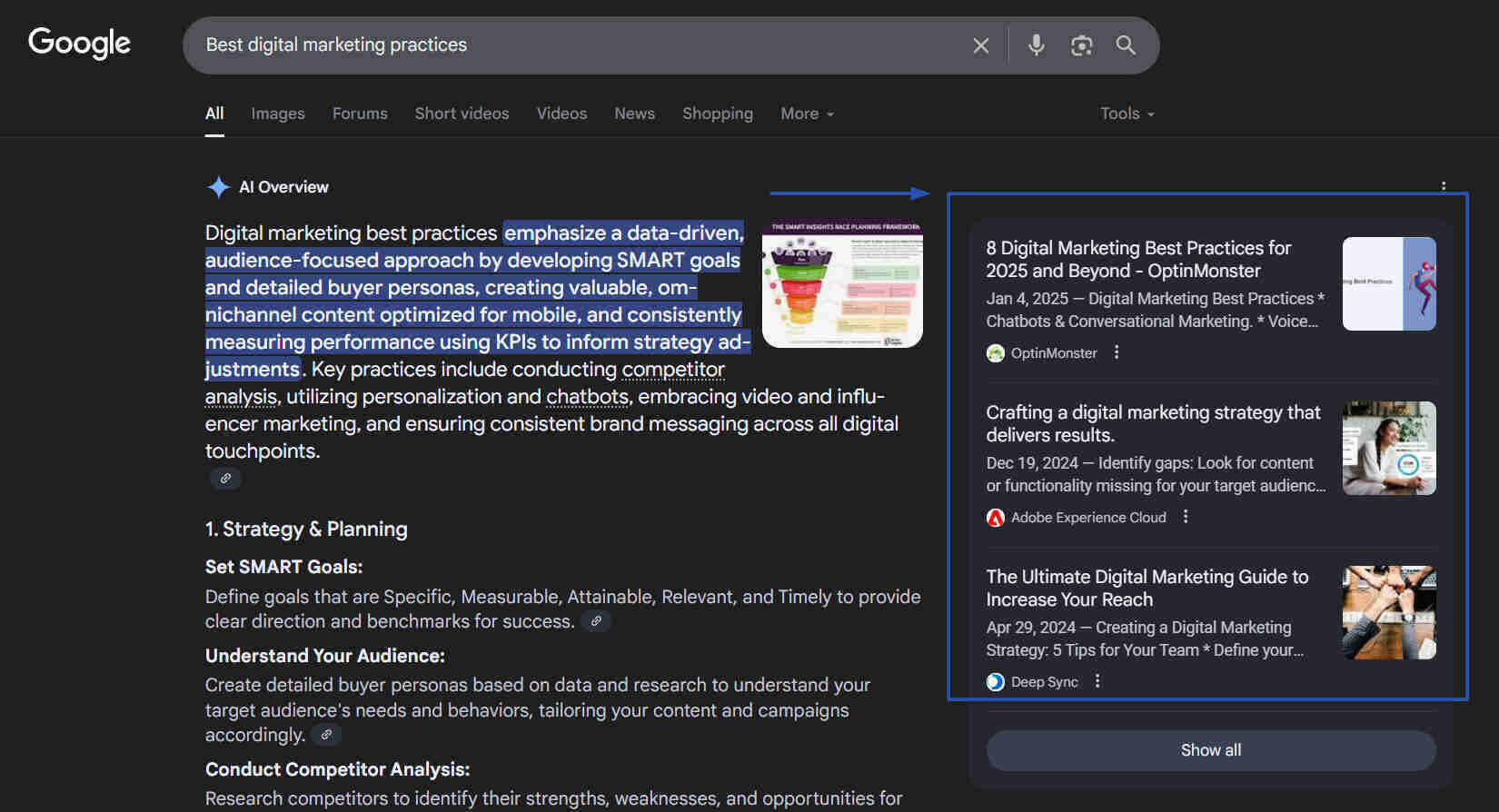
AI Overviews are a Google search feature, powered by a customized version of Gemini; Google’s advanced large language model working alongside its search systems to deliver concise, AI-driven summaries. Google’s AI Overviews leverages generative AI to parse and pull together AI information from numerous web pages across the Web. That allows the AI to provide users with context around a search topic in a concise and comprehensive manner.
You will see AI Overviews show up in your search results when Google believes AI information will be relevant or helpful. There are not many searches overall that will show an AI Overview. That said, the activity is expected to grow over time.
The major mechanisms of an AI overview on Google search include:
Predictive summaries
This function predicts adjacent topics to the topic related to the question and provides additional context. If you searched “best laptops for teachers”, it may also suggest “laptops for coding,” or “laptops for graphic design,” and so on, even if those topics did not appear in the top articles.
Query fan-out
This breaks the query into subqueries and does them all at the same time, helping to uncover different viewpoints. For example, “how does metabolism work & what affects it?” leads to analysis on biological processes, genetics, diet, etc.
Grounding links
These are citations to authoritative sources used by Google to validate the claims in the AI Overview. They are the links from which credibility can be benchmarked, misinformation can be reduced, and trust can be enhanced by by backing bold or factual statements with reliable, high-quality content.
How Google AI overview presents unique SEO challenges?
Lack of transparency
Google has never given clear guidelines on how its AI Overviews select and summarize content. Because of this ambiguity, you are forced to guess as to how you can optimize. Unlike traditional marketing or SEO, where we know how search engines rank content, backlinks, keywords, page speed, etc., Google AI Overviews work with complex language models that evaluate content based on unknown criteria. In other words, unknown situations can happen where well-structured and high-value content doesn’t get picked while some poorly optimized page does. The problem is that all this uncertainty makes success hard to measure or diagnose. So, if you’re investing time and resources into AI Overview optimization without any idea of ROI, it makes it hard to implement a digital strategy for better Google AI search results.
Duplication of content
AI Overviews may duplicate your content without appropriate attribution and provide no benefits in terms of traffic. Whatever you want to call it, this duplication is bad for user engagement because the user finds the answer right there in the search results and has no need to visit your website. The only risk is that maybe in some instances, the advantage will go to competitors if their content is summarized instead of yours, even though their original content is less authoritative than yours or far less expensive than yours in response to Google AI answers. Also, similar content among AI summaries will create redundancy in the broader search ecosystem. It also raises questions on content ownership, originality, and whether there will be mechanisms to reward efforts in creating high-quality original pages as the AI-based search environment unfolds.
Poor quality content
AI Overview on Google tends to prefer content that’s concise, clear, and informative. So any website with thin, outdated, or poorly written content wouldn't stand a chance of ranking on SERPs. Poor formatting, no headings, and no schema markup can also hurt your visibility. AI tools grab information based on the structure of the webpage and the semantic meaning of the content; so, a vague or disorganized page won’t be mentioned at all. Even your good ideas can get ignored if they’re not presented in a machine-readable format. Badly written content can even spread misinformation if the AI search engine misinterprets the content. So to compete well, your content must be both good & technically optimized.
Negative impact on SEO
AI Overviews are zero-click searches; the searchers get their answer right on the results page, so there is no traffic to your site. Even the few clicks you get will be reduced because users will be reading from the summary given by AI rather than your own article; this new phenomenon hurts the main SEO concept, which is to rank high to get traffic. And if AI decides to pick content from your competitor over yours, then that itself can reduce your visibility, though your site may be perfectly optimized.
Frequent algorithm changes
Google has quite a reputation for frequently updating its AI models & AI algorithms. This will change how your content is evaluated & displayed. So what’s suitable today may not be suitable for display in generative AI Overviews tomorrow due to a model change. These changes are sudden & undocumented, so you’re left wondering how to adapt in time. They also flow through structured data, to formatting best practices, to how keywords are used. To stay in the game, you need to track performance, takeover strategies & trends under SEO and AI. This constant flux is an instability factor that makes long-term planning and consistent optimization a real challenge.
Effective SEO strategies for getting featured in AI Overviews
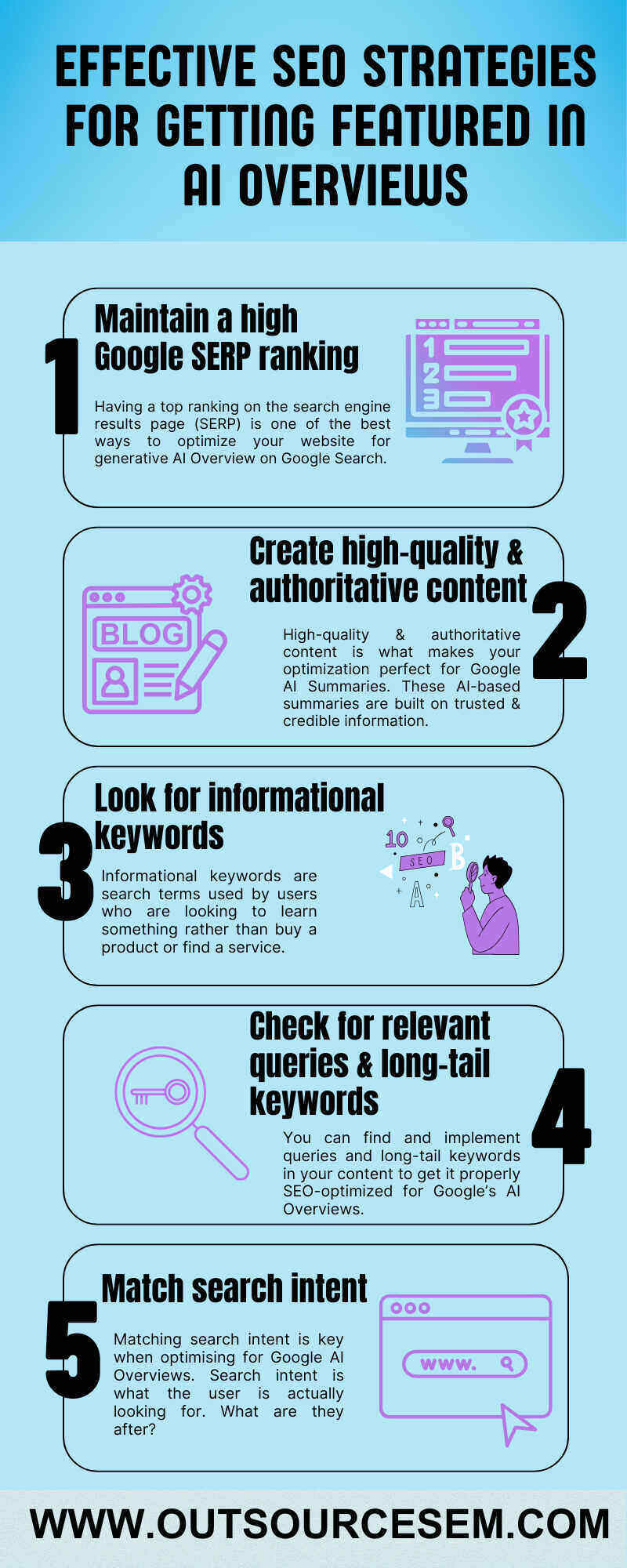
Maintain a high Google SERP ranking
Having a top ranking on the search engine results page (SERP) is one of the best ways to optimize your website for generative AI Overview on Google Search. Google AI Overviews often pull data from top-ranking pages that are usually in the top 5 organic positions. This is because Google’s AI algorithms assume that these pages offer the most relevant, reliable & user-friendly content. You need to have a multi-faceted SEO approach if you want to achieve & maintain a top SERP ranking. First, technical SEO elements like page speed, mobile responsiveness & secure HTTPS connections must be in place. For example, a website that loads in under 2 seconds on both desktop & mobile is more likely to rank well than one that is slow & unoptimized.
Web content also plays a big role. Your pages should address user intent thoroughly & provide clear & well-organized information. Your content is more likely to rank high if it’s organized logically with headers, includes detailed instructions & internal links to related topics & images. SEO backlinks are another critical component for your website. It signals trustworthiness to Google when other authoritative websites link to your page. Finally, user engagement metrics such as low bounce rate, high time-on-page, & good click-through rates (CTR) also influence rankings. Your website is going to be selected by Google's AI for an overview of whether your well-designed page can satisfy user expectations and rank high.
Create high-quality & authoritative content
High-quality & authoritative content is what makes your optimization perfect for Google AI Summaries. These AI-based summaries are built on trusted & credible information, which is often taken from content that shows expertise, depth & credibility. Your content must be researched & factually correct if you want your website to meet this standard. If you’re writing articles that require data, you need to reference studies from peer-reviewed journals, cite authoritative references & avoid unverified claims. This tells Google’s AI algorithms that your content can be trusted.
A second source of authority comes from authorship credentials and your website’s reputation. Adding a bit of authenticity can be done by including an author bio with qualifications. Your high-quality content should be thorough but easy to understand. It should answer the user’s question directly and also address subtopics.
You can boost your content by adding multimedia elements like charts, images & videos. This makes it more engaging & informative. Ultimately, regularly updating your content ensures accuracy & relevance is taken into account by AI when choosing sources. In short, authoritative, well-structured & deeply researched content is more likely to be included in Google AI Summaries, increasing your organic visibility and user trust.
Look for informational keywords
Informational keywords are search terms used by users who are looking to learn something rather than buy a product or find a service. AI overviews prefer informational keywords over transactional keywords as they help you optimize your content to show up in Google’s AI Overviews. These keywords usually start with question words like “what,” “how,” “why,” or phrases like “guide to,” “tips for,” “ways to.” If your content targets these keywords, you’re more likely to be included in Google AI summaries as AI overviews are designed to answer these types of questions quickly & accurately.
For example, a user might search for “What is intermittent fasting?” or “How does solar energy work?” These are informational queries. You increase your chances of being selected for an AI Overview snippet if you create content that answers those questions clearly.
Keyword research tools can also help you find high-traffic informational keywords in your niche. Once you find them, you increase your chances of being selected for a generative AI Overview snippet. You can incorporate them naturally in your headings, meta tags, and throughout the body content. Also, make sure your content matches the intent behind the query. For example, if someone searches “how to brew coffee,” they’re expecting a step-by-step process and not a long history of coffee.
Your content can become a top candidate for AI-generated summaries if you target informational keywords & address user intent directly. This will get you more visibility & trust from users looking for reliable information.
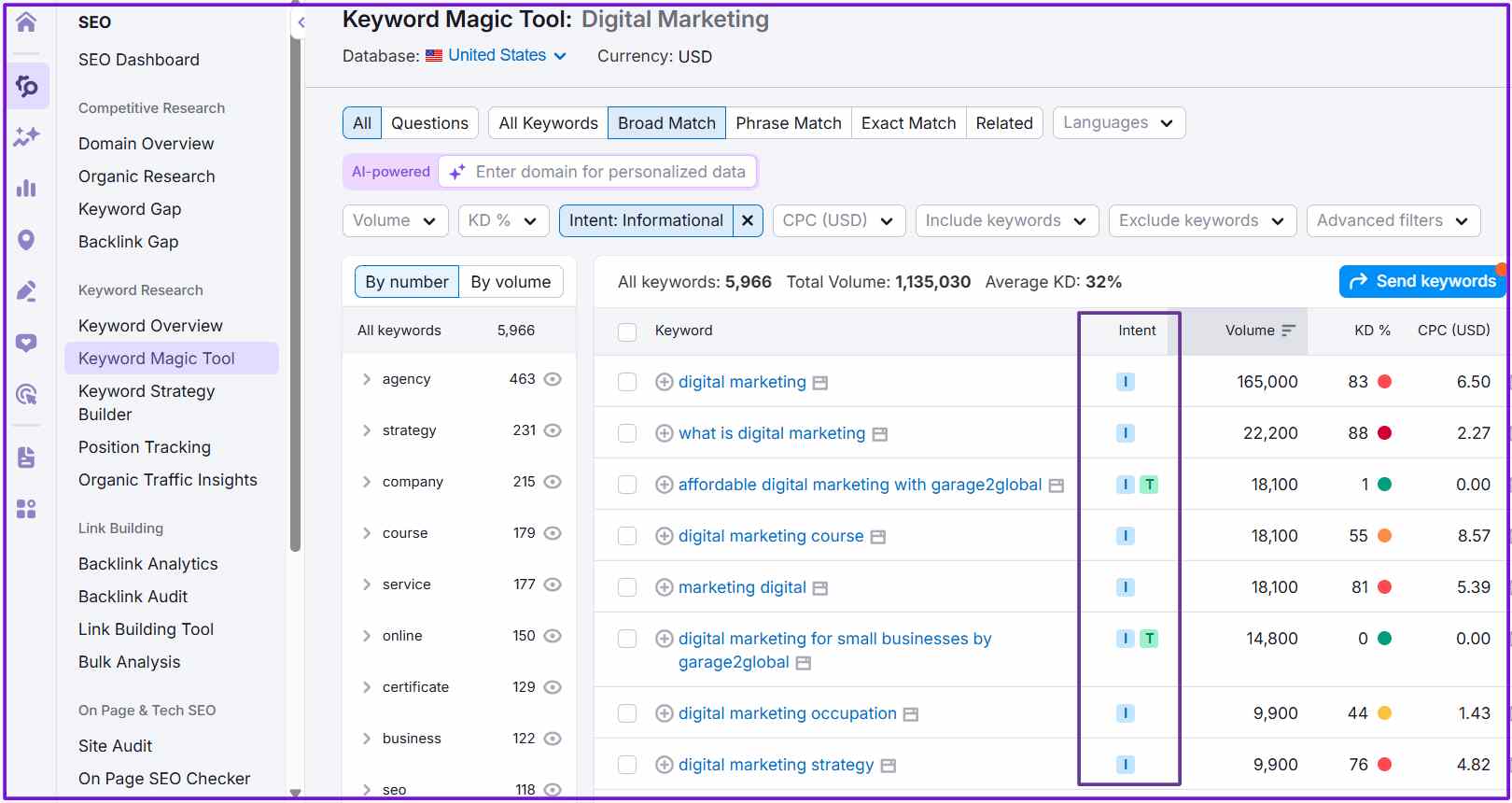
Check for relevant queries & long-tail keywords
You can find and implement queries and long-tail keywords in your content to get it properly SEO-optimized for Google’s AI Overviews. Long-tail keywords are longer and more specific words or phrases people use when they search in natural language. Queries are usually direct transcriptions of how people ask questions in real life, which is exactly what AI Overviews are supposed to answer in more detail. For example, instead of going for just the broad term “digital marketing,” consider a long-tail keyword like “effective digital marketing strategies for small businesses” that will get more qualified traffic and show in AI snippets
You can use tools like Google’s “People Also Ask” or Google Search Console and Google Keyword Planner to get these keywords. These platforms give you actual phrases people are searching for, so you can shape your content around them. For example, if you have a travel blog and find that people search for “how to plan a budget trip to Europe”, writing a comprehensive guide using that exact phrase in the title and headings will be a great idea. Google and its AI can identify the value and relevance of your page and hence consider it for AI Overviews when your content is aligned with those specific and intent-oriented queries.
Match search intent
Matching search intent is key when optimizing for Google AI Overviews. Search intent is what the user is actually looking for. What are they after? Generally, there are three types of intent: informational (looking for knowledge), navigational (looking for a specific website), and transactional (buying something). These AI Overviews are informational in intent, so the content should answer the user’s question clearly, directly, and accurately.
For example, if a user searches for “how to lose weight safely,” then they’re not looking for diet pills or gym membership ads because they want practical, evidence-based guidelines. This intent would be served by an article with a step-by-step approach with sections on a balanced diet, exercises, sleep, and hydration. Using headings like “Healthy Meal Ideas” or “Beginner Workout Plans” will further order the information so it’s easy to understand for both users and AI.
If you deviate from creating content that matches the intent, i.e., promoting products or writing a bunch of vague general info, the AI will just ignore it. Your content should match user intent, and that will make it rank higher and can even be included in Google AI Overviews. So basically, you have to know what users are looking for when they type in a query and present that information clearly and completely.
Use plain language
When you’re optimizing for Google’s AI Overviews, you need to use plain language because the AI looks for information that’s super easy to get and super fast to consume. Content written in simple, clear, and conversational language has a higher chance of being understood and summarised by Google’s AI systems. Avoid technical jargon and big words, and your content will reach a wider audience, including those with less expertise.
For example, instead of writing “Hydration is key to optimal physiological performance,” write “Drinking enough water helps your body work”. This is much more readable for everyday readers, and AI systems can easily see it’s a direct and helpful answer.
Formatting is another thing to consider for clarity. Short paragraphs, bullet points, and subheadings break down complex ideas into bite-sized chunks. The sooner users and AI can find the core of the content and get it, the better their chances are that the AI will want to include it in an overview.
A plain language formulation will help the user and also Google’s purpose of providing fast and accurate AI-generated answers. If you build your content along clear lines, crisp and to the point, your content will be more likely to be selected to feature in an AI-generated summary.
Perform on-page optimization
On-page optimization means improving your individual web pages so they are well structured, semantically rich, and informative for users & artificial agents like Google’s AI Summaries. Since AI Summaries pull and summarise content from the page itself, it’s super important that the content on your page is well organised and easy for an algorithm to understand, ultimately helpful in AI overview optimization.
You need to start with descriptive headings to organise content within logical sections. Next, provide clear and concise AI-generated answers to common questions at or near the top of the page. You can do this in a paragraph, list, or table format. This is how AI Summaries like to feature content. Then you can use schema markup to tell AI-powered search engines what your content is about.
Structuring your content to be answer-focused and semantically rich increases your chances of getting your content featured as Google AI summaries by AI Summaries.
Conclusion
With each passing day, Google is continuing to improve the AI-powered search experience with AI features like AI Overviews and now the newly launched AI Mode, so it is not just an optional change to your SEO plan anymore. Understanding the concept of generative AI Overviews will give you a basis to produce content that is high quality and educational, in a format to allow AI to understand. Use simple formatting and schema formatting; develop short and concise content that is focused on the primary points that answer questions and reinforces businesses with the authority to be ranked highly by AI, allowing the AI models to provide even more confidence to surface their names. Growth can also come with difficulties: limited control, non-transparent behavior, changing AI algorithms requiring constant vigilance, and flexibility.
OutsourceSEM is the best digital marketing agency in India. We can help you keep your business ahead with data-driven SEO audits and migrating AI strategies so your business website can continue to have visibility and relevancy within this AI-based search reality. Also, provide our digital marketing services to different type of industries as well which is designed by our experienced marketing experts such as electricity digital marketing services, construction digital marketing services, plumbing digital marketing services, appliance repair digital marketing services, painting digital marketing services, HVAC digital marketing services, roofing digital marketing services, flooring digital marketing, and other online marketing services. From digital marketing, SEO to PPC, Social Media, and Web design, we do it all, and provide our top-notch online marketing solutions globally.
Reference links:
1. Mastering AI Overviews For Greater Search Visibility
2. AI SEO: How to be visible in Google AI Overviews, chatbots, LLMs