
Have you ever searched for something related to your business on ChatGPT or Google AI Overviews, only to find your competitors appearing in the answers while your brand is nowhere to be seen?
It's becoming a common concern for businesses investing in SEO. Your website might rank well on Google, your content might be informative, and your services might be exactly what people are searching for. Yet AI-powered search platforms don't always mention your business.
So, what's stopping your brand from appearing?
An AI search audit can help you find out. It looks at how your brand appears across AI search platforms, which websites are being cited, and whether technical problems, content gaps, or stronger competitors are affecting your visibility.
The process involves testing relevant customer questions, checking your website's accessibility, studying competing sources, and making improvements based on what you discover.
What is an AI search audit?
An AI search audit is a way to understand how visible your brand is when people use AI-powered search tools to find information, compare businesses, or explore services.
A traditional SEO audit mainly focuses on keyword rankings, organic traffic, technical issues, and website performance. An AI search audit takes things further by looking at the actual answers people receive.
For example, your business might appear in an AI-generated answer as a recommended service provider. Another time, the platform might link to one of your articles without mentioning your company name.
These are two different outcomes, and both are worth tracking.
It's also important to understand that AI platforms don't always provide identical answers. Google AI Overviews, Google AI Mode, ChatGPT search, and Microsoft Copilot can respond differently to the same question.
That's why checking a single answer isn't enough to judge your overall visibility.
Step 1: Identify the questions your customers are asking
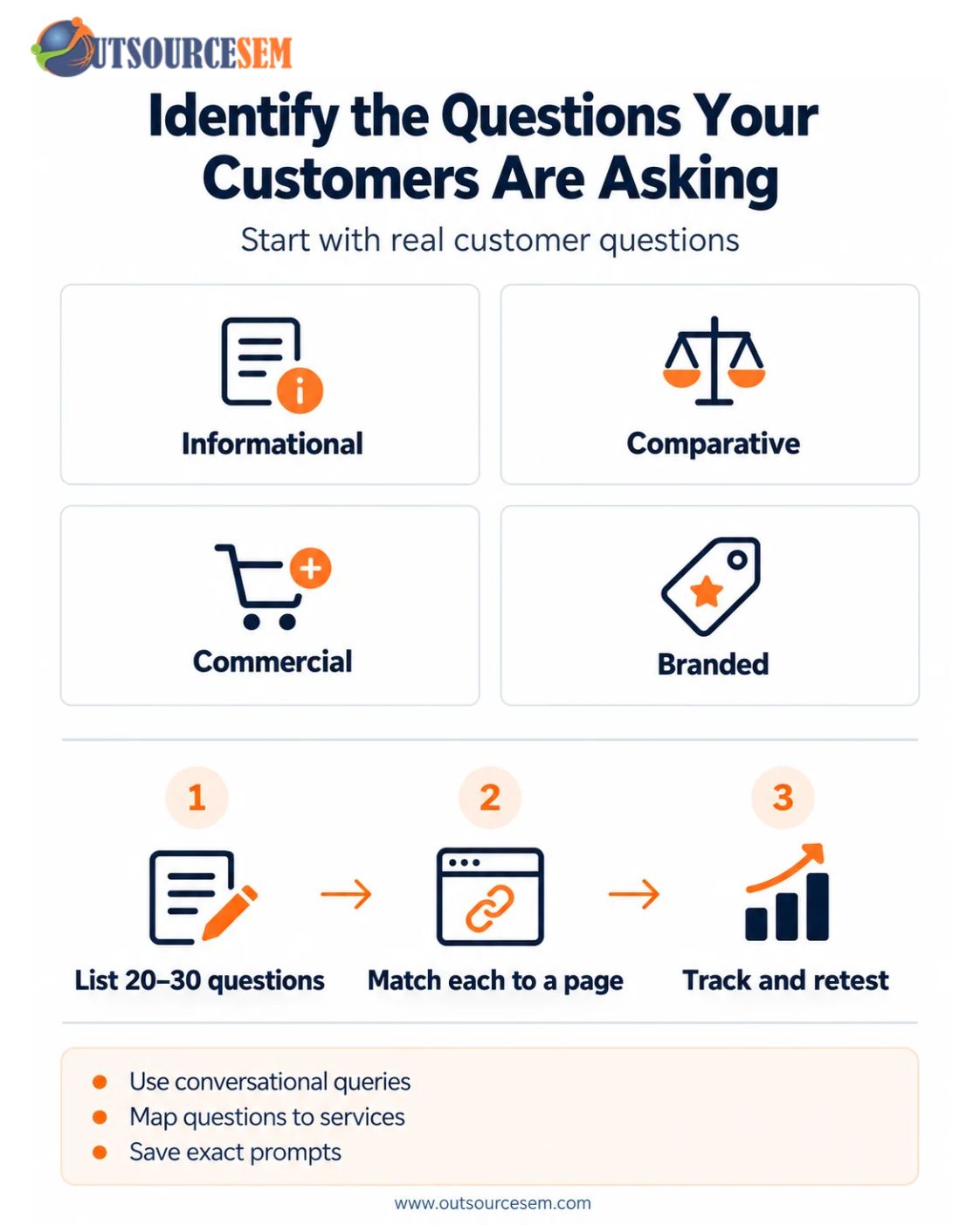
Before you start checking AI search results, think about what your potential customers actually want to know.
Traditional SEO often begins with keyword research and search volumes. While those still matter, AI search queries tend to be more conversational. People ask detailed questions, compare options, and look for recommendations based on their specific needs.
For example, someone researching digital marketing services might ask:
- Informational: What should businesses know before outsourcing SEO?
- Comparative: Which agency services are suitable for growing businesses?
- Commercial: What should I consider when choosing a white-label marketing provider?
- Branded: What services does a particular company offer, and who are they for?
These questions give you a better picture of where your brand should realistically appear.
Once you've identified them, connect each question to a relevant page on your website. Think about what someone should do after reading that page, whether it's exploring a service, requesting a quote, or contacting your team.
Start with around 20 to 30 questions covering your main services and customer needs. Keep a record of the exact wording so you can use the same questions when reviewing your progress later.
Step 2: Check where your brand appears in AI answers
Now it's time to see how AI platforms respond to those questions.
Enter your selected prompts into ChatGPT search, Google AI Overviews, Google AI Mode, or other platforms relevant to your audience.
For each question, record the response, date, platform, websites cited, and businesses mentioned.
Rather than simply checking whether your brand appears, focus on four important areas:
- Brand mentions: How often does an AI-generated answer mention your business?
- Website citations: How often does the platform link to or reference your website?
- Competitor visibility: Which competing businesses appear when yours doesn't?
- Answer accuracy: Does the platform describe your services and business correctly?
Let's say you test 30 questions and your brand appears in six answers. Your observed brand mention rate would be 20%.
That gives you a useful starting point, but it doesn't mean your business appears in 20% of all AI searches. It only reflects the questions and responses included in your test.
Also, remember that getting cited isn't always the same as being recommended.
An AI platform might use your blog to explain a marketing concept without suggesting your agency as a service provider. Both types of visibility can help people discover your business, but they serve different purposes.
Step 3: Check whether technical issues are holding you back
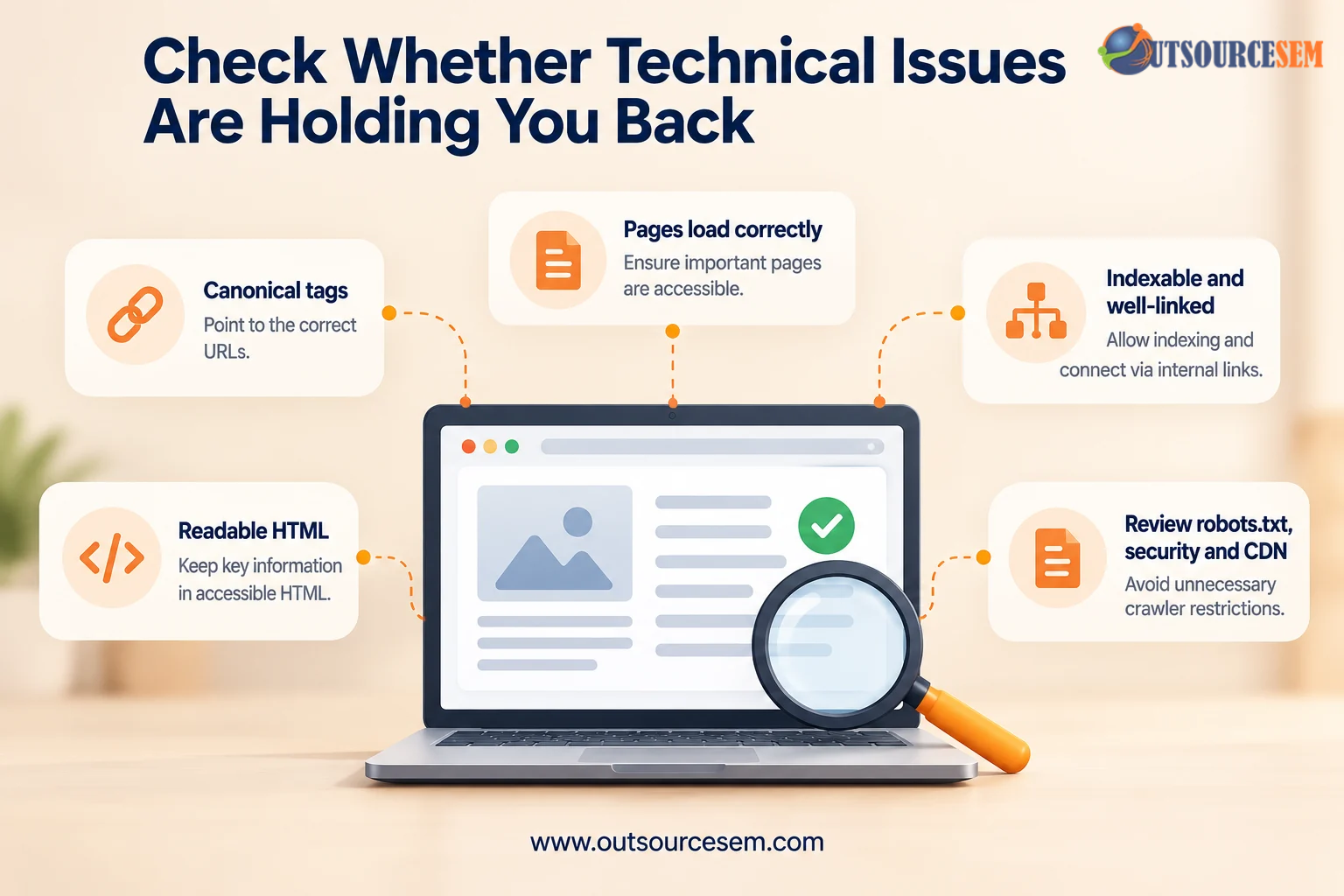
Sometimes, the problem isn't your content. It's whether search engines and AI crawlers can access it properly.
Even a useful, well-written page may struggle to appear in AI search results if technical settings make it difficult to discover or understand.
Start by checking the basics:
- Make sure important pages load correctly and aren't accidentally blocked.
- Check that canonical tags point to the correct URLs.
- Confirm that relevant pages can be indexed and are connected through internal links.
- Keep important website information accessible in readable HTML.
- Review robots.txt rules, security settings, and CDN configurations for unnecessary crawler restrictions.
Different platforms also have different crawling requirements.
For example, Google uses its existing Search index and snippet eligibility requirements for supporting links in AI Overviews and AI Mode. You don't need special AI-only markup to become eligible.
OpenAI, meanwhile, uses a crawler called OAI-SearchBot for ChatGPT search discovery. This is separate from GPTBot, which is associated with model-training purposes.
It's worth checking whether your website permits access to the crawlers relevant to your visibility goals.
However, being crawlable doesn't automatically mean your content will appear in an AI answer. It simply helps remove one potential obstacle.
Step 4: Find out why competitors are being cited instead
If your competitors repeatedly appear in AI-generated answers while your brand is missing, take a closer look at what their content offers.
Choose a few important customer questions where competing websites are being cited. Open those pages and compare them with the most relevant content on your own website.
Ask yourself:
- Does the competing page answer the question more directly?
- Does it include useful examples or practical explanations?
- Does it explain pricing factors, limitations, or different use cases?
- Are its claims supported by reliable information?
- Does it clearly demonstrate the company's experience or expertise?
You might discover that your page discusses a service in general terms, while a competitor explains exactly how it works, who it's suitable for, and what customers should consider before choosing it.
That difference can make the competing content more useful to someone asking a specific question.
To keep things organised, create a comparison sheet containing the customer question, your relevant URL, cited competitor URLs, and any content gaps you identify.
Look for patterns rather than making changes based on one result.
If several important questions reveal the same weakness, that's a good place to focus your improvements.
Step 5: Make your content more useful for AI search
Once you've identified content gaps, the next step is to improve the pages that matter most.
This doesn't mean rewriting everything for AI or filling your content with more keywords.
Instead, focus on making your pages genuinely helpful to people looking for answers.
Start by placing a clear answer close to the heading that introduces the question. Then expand on it with useful explanations, examples, and practical advice.
You can also strengthen your content by:
- Replacing broad marketing claims with specific information about your services.
- Including real examples, original insights, or properly sourced research.
- Explaining who your services are suitable for and when another option might work better.
- Updating information that is outdated or no longer accurate.
- Adding relevant internal links that help visitors explore related topics.
For example, instead of simply saying your agency offers effective SEO solutions, explain the process, the problems those services address, and what clients can realistically expect.
You can also use appropriate structured data to help search engines interpret supported information on your pages. Just remember that adding schema markup doesn't guarantee an AI citation.
The same principle applies to FAQs. They should answer questions people genuinely have, not exist solely to repeat keywords.
And there's no need to publish dozens of articles covering almost identical questions. A well-researched, comprehensive guide can often provide more value than several short pages repeating the same information.
Step 6: Look at how your brand appears beyond your website
Your website isn't the only place where information about your business exists.
Potential customers may discover your company through industry publications, business directories, professional profiles, partner websites, or independent reviews.
These sources can also contribute to how your business is represented online.
Imagine your website describes your company as a specialist in white-label SEO services, but several external profiles use outdated descriptions or list services you no longer provide.
That inconsistency is worth fixing.
Review important details such as your company name, services, locations, official profiles, and publicly available business information.
Where you can control the information, correct anything inaccurate or outdated.
It's also worth looking at how competitors demonstrate their experience beyond their own websites.
Do they publish original research? Are they featured in relevant industry publications? Do they have useful case studies or credible third-party references?
These activities can help establish genuine credibility.
The aim shouldn't be to create artificial brand mentions or purchase reviews. Instead, focus on building a stronger public presence through real expertise, useful information, and trustworthy coverage.
Sometimes, improving AI search visibility means strengthening your business's credibility rather than changing a few headings on your website.
Step 7: Use the right tools to track AI search visibility
You don't have to rely entirely on manually checking AI-generated answers.
Some of the SEO tools you already use can provide helpful information, although it's important to understand what each tool actually measures.
Google Search Console can help you review search performance, indexing status, and technical accessibility. However, its standard reports shouldn't be treated as a complete record of every AI citation or brand mention.
Bing Webmaster Tools provides an AI Performance report for supported Microsoft AI experiences. It includes information such as citation activity, cited pages, and grouped queries used for grounding AI responses.
This can help you understand which pages are being referenced, but it doesn't explain every reason behind those citations.
You can also explore third-party AI visibility tracking tools that monitor prompts, brand mentions, and competing websites.
Before relying on their reports, check which platforms they cover, how frequently they collect results, and whether their testing methods are consistent.
No single platform provides a complete picture of every AI-generated answer.
For more meaningful reporting, look at trends across individual platforms and groups of related questions. Where possible, connect visibility changes with actual business outcomes, such as qualified website visits, enquiries, or contact form submissions.
After all, getting mentioned is useful, but attracting the right customers matters more.
Turn your AI search audit into an action plan
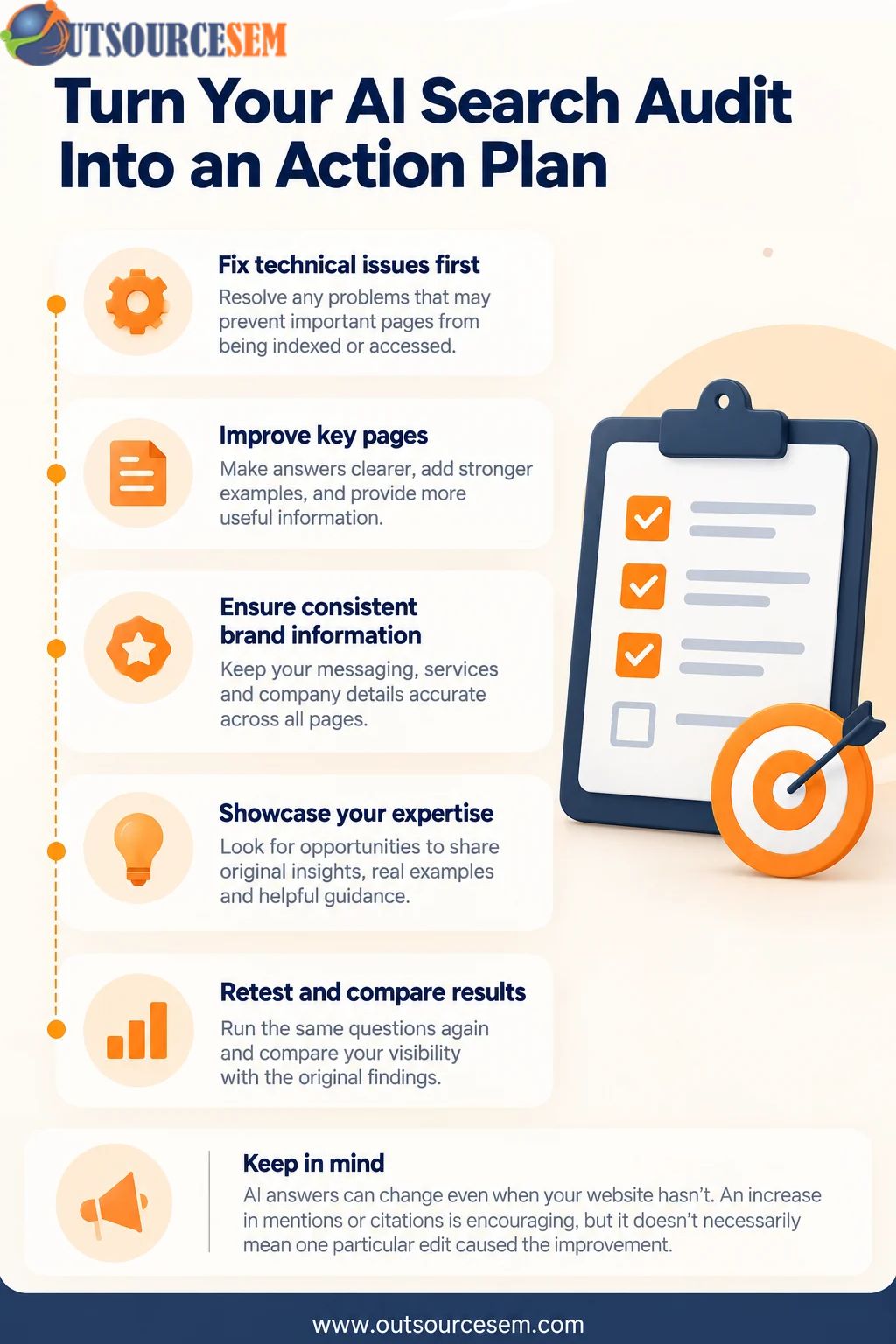
An AI search audit is only valuable if you use the findings to make improvements.
Once you've reviewed your technical setup, website content, competitor visibility, and brand information, decide which issues deserve attention first.
Begin with technical seo problems that may prevent important pages from being indexed or accessed.
Next, work on pages that already match valuable customer questions but need clearer answers, stronger examples, or more useful information.
After that, address inconsistent brand details and look for opportunities to demonstrate your expertise more effectively.
Once the changes are live, test the same questions again and compare the results with your original findings.
Keep in mind that AI answers can change even when your website hasn't. An increase in mentions or citations is encouraging, but it doesn't necessarily mean one particular edit caused the improvement.
The real goal isn't to make your brand appear in every AI-generated answer. It's to give AI search platforms and potential customers clear, reliable reasons to consider your business when it's relevant to what they're looking for.