
Overview
Search Engine Optimisation (SEO), now evolving into Answer Engine Optimisation (AEO), goes far beyond simply adding keywords to pages and building backlinks. Sustainable performance depends on useful content, technical accessibility, clear site structure, credible expertise and a strong understanding of user intent. Businesses must also consider how their content appears in AI-generated answers.
These ten strategies aim to improve organic visibility, attract relevant visitors and generate leads.
Quick Answer
The most effective long-term search engine optimisation strategy is to create useful content around customer needs, maintain a technically accessible website, organise pages through deliberate internal linking and build authority through credible evidence and relevant backlinks. AI tools can support research and analysis, but human expertise, originality, accuracy and continuous measurement remain essential.
Introduction
Search behaviour is becoming more detailed, conversational and fragmented. A potential customer may begin with Google, compare options through an AI-generated answer and return later through a branded search. SEO must support the full journey rather than one keyword or ranking position.
Google confirms that foundational SEO practices remain relevant to AI Overviews and AI Mode. Pages still need to be indexed, eligible to appear in Search, and supported by helpful, reliable, people-first information. There are no separate technical shortcuts that guarantee inclusion in these AI features.
A successful strategy connects search demand with business value. It identifies the questions customers ask, provides clear answers, removes technical barriers, and guides users towards a meaningful next step.
1. Understand Search Intent Before Selecting Keywords
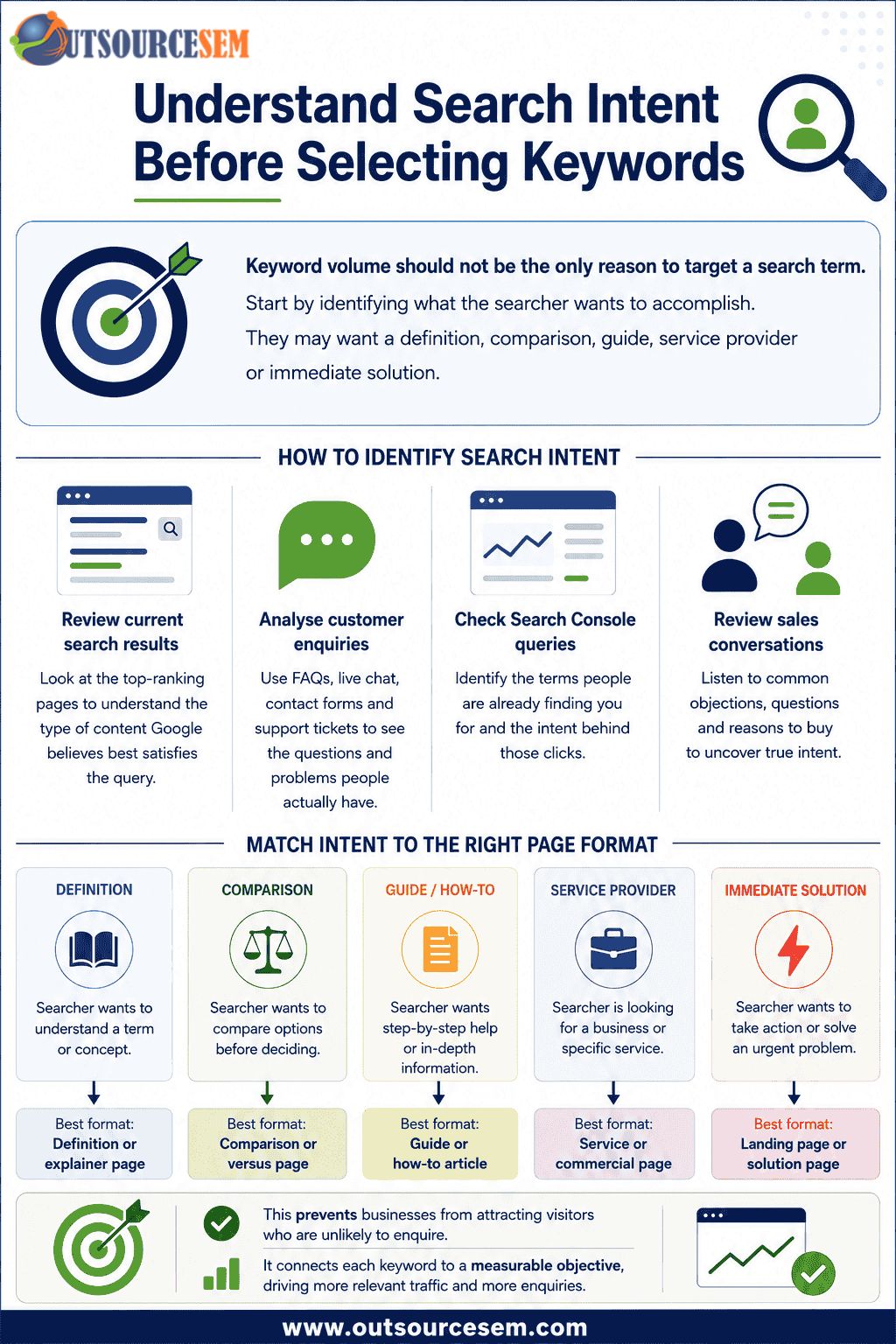
Keyword volume should not be the only reason to target a search term. Start by identifying what the searcher wants to accomplish. They may want a definition, a comparison, a guide, a service provider, or an immediate solution.
Review current search results, customer enquiries, Search Console queries and sales conversations to understand that intent. Then select the most suitable page format. A service-led query usually needs a commercial page, while an educational question may need a guide.
This prevents businesses from attracting visitors who are unlikely to enquire and connects each keyword to a measurable objective.
2. Provide the Main Answer Early
Users should not need to read several introductory paragraphs before finding the answer the title promises. Place a clear summary, recommendation, or definition near the beginning, then expand it with supporting detail.
An answer-first structure improves time to value and makes essential passages easier to understand when shown outside their original context. This can support featured results and AI-generated summaries.
Use descriptive headings, focused paragraphs, and tables only where they improve understanding. The structure should serve the reader first.
3. Create Helpful, Original Content
Content should offer more than a rewritten version of information already available on competing websites. Add original examples, tested methods, practical observations, proprietary data or informed professional opinions where possible.
Google’s systems are designed to prioritise helpful, reliable content created for people rather than pages produced mainly to manipulate rankings. Its guidance also recommends making the creator, production process and purpose of important content clear when readers would reasonably expect that information.
Avoid unnecessary length, repetitive definitions and unsupported claims. Every section should help the reader understand the topic or make a decision.
4. Use AI as a Supporting Tool
AI can accelerate keyword grouping, competitor comparison, outlining, data analysis and technical troubleshooting. However, its output must be checked by a knowledgeable person.
Generic text, invented statistics, and unverified recommendations weaken trust. Google states that generative AI can help with research and structure, but publishing many pages without adding user value may violate its scaled content abuse policy.
Use AI to improve efficiency while keeping strategy, fact-checking, examples and final editorial decisions under human control.
5. Strengthen Experience, Expertise and Trust
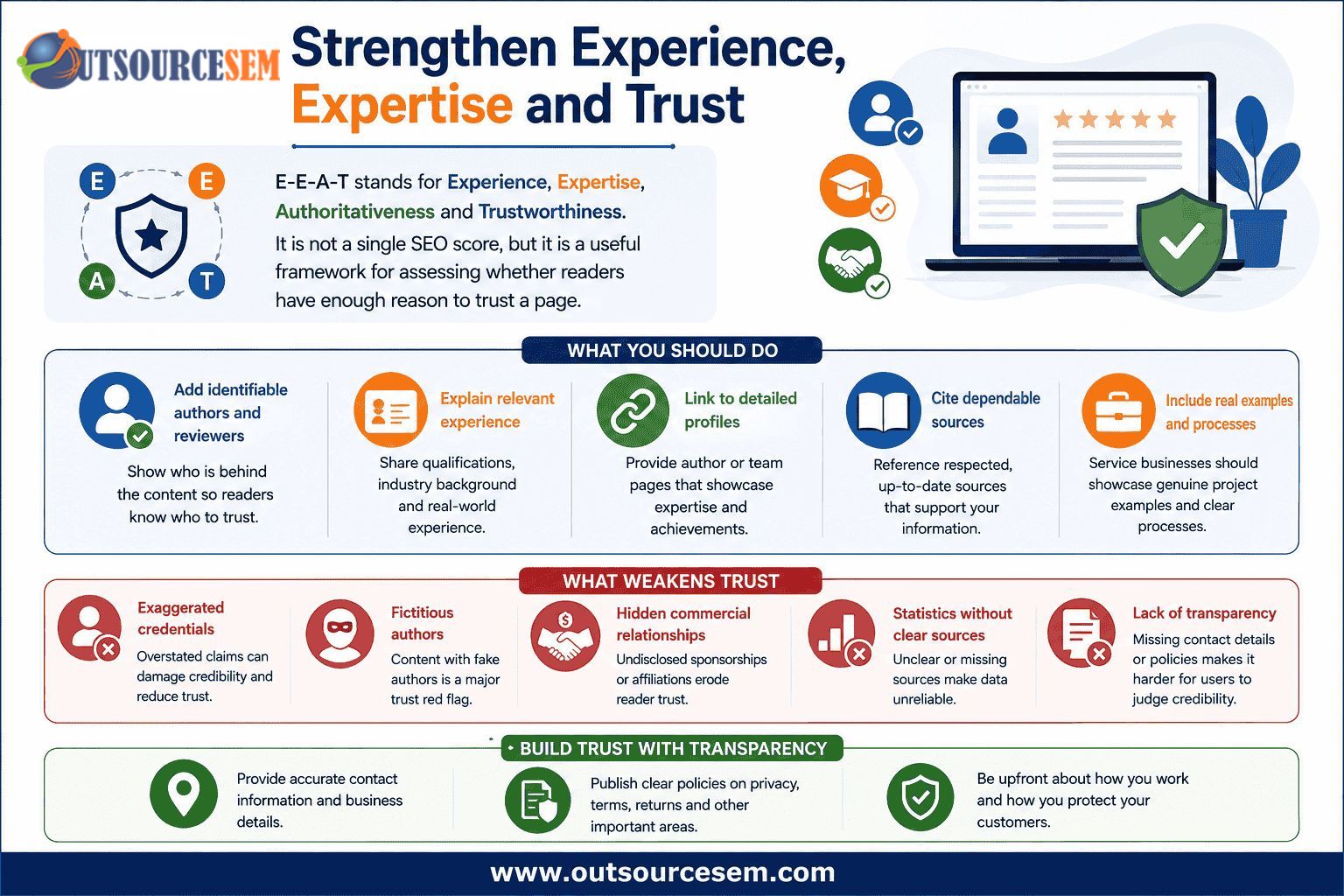
E-E-A-T stands for Experience, Expertise, Authoritativeness and Trustworthiness. It is not a single SEO score, but it is a useful framework for assessing whether readers have enough reason to trust a page.
Add identifiable authors and reviewers where appropriate. Explain their relevant experience, link to detailed profiles and cite dependable sources. Service businesses can include genuine project examples and processes.
Trust is weakened by exaggerated credentials, fictitious authors, hidden commercial relationships and statistics without clear sources. Accurate contact information and transparent policies also help users judge credibility.
6. Maintain Technical SEO Foundations
Valuable content cannot perform properly when search engines cannot access, render or index it. A website SEO audit should examine robots directives, XML sitemaps, canonical tags, redirects, status codes, duplicate pages, mobile rendering, and structured data.
Important content should be available in crawlable text rather than appearing only inside images or inaccessible interactive elements. Structured data should accurately reflect information visible on the page.
Core Web Vitals measure real-world loading performance, interactivity and visual stability, but good scores alone do not guarantee rankings. Technical improvements should be prioritised according to their effect on users, important pages and conversions.
7. Build a Deliberate Internal Linking Structure
Internal links help visitors move between related resources and help search engines discover and understand pages. Link from relevant articles and authoritative pages to important services, category pages, and conversion content.
Use anchor text that describes the linked page. Avoid forcing the same keyword into every link or adding unrelated links only to reach a numerical target.
Every important page should be reachable through crawlable links. Google explains that links help it find new pages and assess relevance, making internal linking essential to navigation and SEO.
8. Refresh Content and Reduce Cannibalisation
.png)
Refresh content when its facts, examples, search intent, traffic, rankings or conversion performance change. Update obsolete recommendations, improve unclear sections and add missing information.
Where two or more pages target the same intent, decide whether they should be consolidated, redirected or differentiated around separate customer needs.
Not every declining page needs an update. Search demand may have fallen, the business may no longer offer the service, or another page may satisfy the query more effectively. Analyse the cause before investing resources.
9. Earn Relevant Backlinks and Brand Mentions
Backlinks remain valuable when they come from relevant, credible websites and are earned through genuine editorial value. Original research, useful guides, expert commentary, practical tools and case studies can give publishers a legitimate reason to reference a business.
Digital PR, partnerships and selective guest contributions can support this process. Avoid buying large quantities of links, using private networks or placing keyword-heavy links on irrelevant websites.
Brand mentions across reputable publications, communities and business profiles can also increase recognition. Keep important facts and positioning consistent wherever the business appears.
10. Measure Leads, Not Rankings Alone
Rankings and traffic are useful indicators, but they do not show whether SEO is generating commercial value. Measure enquiries, qualified leads, calls, form submissions, conversion rates, assisted conversions and revenue where accurate attribution is available.
Use Google Search Console to review queries, impressions, clicks, and position. Compare performance before and after meaningful content or technical changes instead of reacting to daily ranking fluctuations.
Monitor referral traffic from AI platforms and branded search demand where relevant. These signals can reveal whether content is influencing discovery beyond conventional organic clicks.
Conclusion
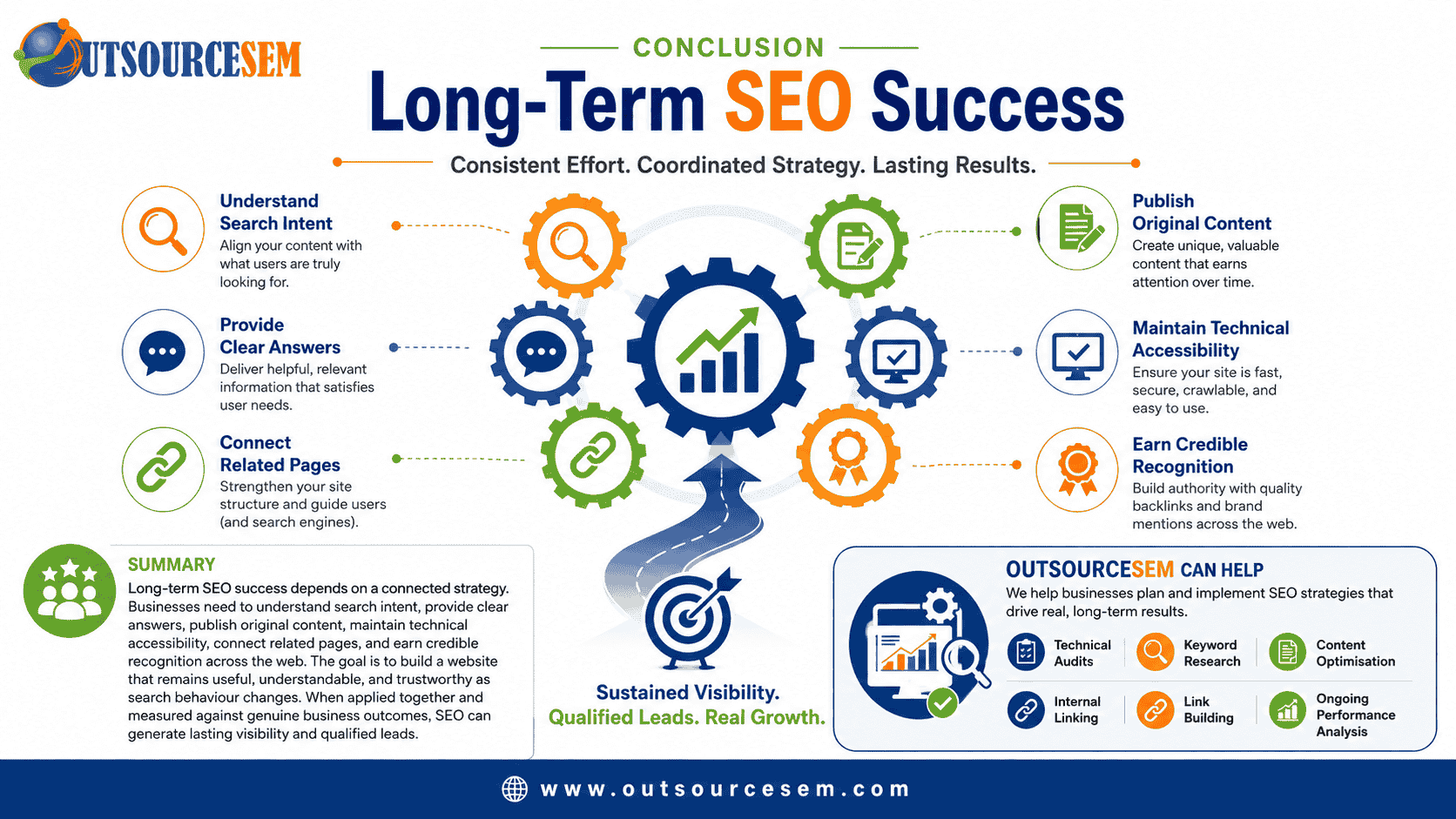
Long-term search engine optimisation depends on consistent, coordinated work. Businesses need to understand search intent, provide clear answers, publish original content, maintain technical accessibility, connect related pages and earn credible recognition across the web.
The goal is to build a website that remains useful, understandable and trustworthy as search behaviour changes. When these strategies are applied together and measured against genuine business outcomes, SEO can generate lasting visibility and qualified leads.
OutsourceSEM helps businesses plan and implement search engine optimisation strategies covering technical audits, keyword research, content optimisation, internal linking, link building and ongoing performance analysis.