
Introduction
Every business needs a website audit before starting AEO because search engines must be able to crawl, understand and trust your website before they can show your content to users.
Starting Answer Engine Optimisation without checking your website first can lead to wasted effort. You may invest in keyword research, blogs, backlinks, FAQs and content updates, but if your website has technical errors, indexing issues, weak content, poor structure or unclear answers, your AEO and SEO efforts may not deliver strong results.
A website audit gives your business a clear starting point. It shows what is working, what is holding the website back and what needs to be fixed before a long-term AEO strategy begins.
What Is a Website Audit for AEO?
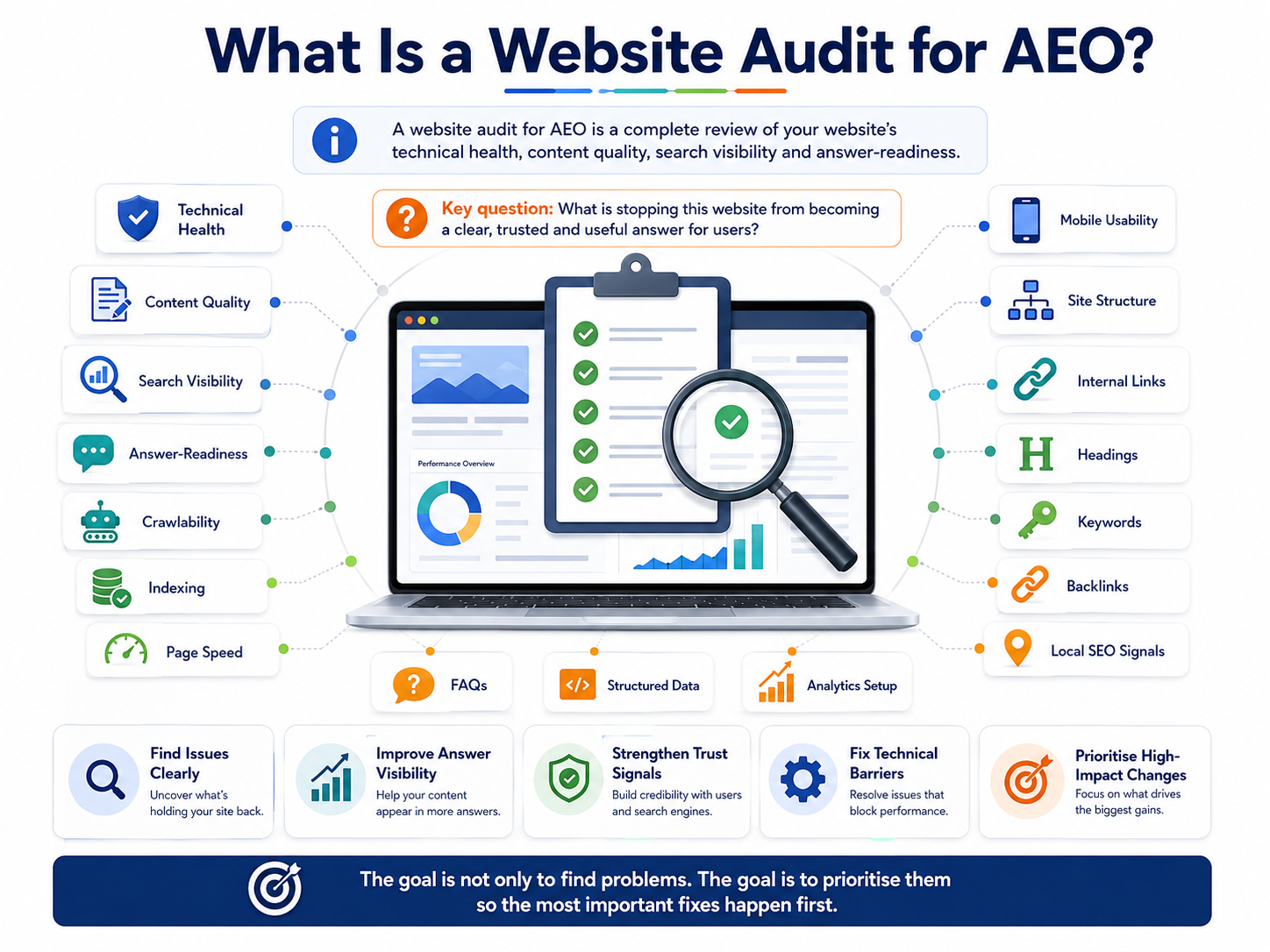
A website audit for AEO is a complete review of your website’s technical health, content quality, search visibility and answer-readiness.
It answers one key question: what is stopping this website from becoming a clear, trusted and useful answer for users?
A complete website audit reviews crawlability, indexing, page speed, mobile usability, site structure, internal links, headings, content, keywords, backlinks, local SEO signals, FAQs, structured data and analytics setup.
The goal is not only to find problems. The goal is to prioritise them so the most important fixes happen first.
Why Is a Website Audit Important Before Starting AEO?
A website audit is important before starting AEO because it shows whether your website is ready to answer user questions and compete in modern search.
Before creating new content, adding FAQs or targeting question-based keywords, you need to know whether search engines can crawl, index and understand your key pages.
A website audit answers important questions. Are your main pages indexed? Can search engines crawl your website properly? Is your website slow? Does your content match search intent? Do your pages answer direct questions clearly? Are your backlinks helping or harming the site? Is conversion tracking working?
Without these answers, AEO may focus on the wrong tasks.
AEO Without a Website Audit Is Guesswork
AEO should be based on data, not assumptions.
A business may assume it needs more FAQs or more blog content to appear in answer-based results. However, a website audit may reveal that important service pages are not indexed, title tags are duplicated, internal linking is weak or existing content does not answer questions clearly.
A website can look professional but still have serious optimisation issues. It may load slowly, target the wrong keywords, duplicate content across pages or attract visitors without converting them.
An audit replaces assumptions with evidence.
How Technical SEO Supports AEO
A technical SEO audit checks the backend elements that affect how search engines access, crawl and understand your website.
It reviews crawl errors, indexing problems, broken links, page speed, mobile usability, sitemaps, robots.txt settings, redirects, duplicate pages, canonical tags, 404 errors, URL structure and structured data.
This matters for AEO because answer-focused content cannot perform well if search engines cannot access or understand it.
If important pages are blocked, slow, poorly structured or not indexed, your website may miss both ranking opportunities and answer-based visibility.
How an AEO-Focused Audit Review Answers Readiness
An AEO-focused audit checks whether your content is structured to answer user questions clearly.
It reviews whether your pages answer the main question early, use clear headings, include relevant FAQs, explain topics in simple language, match user intent, cover related follow-up questions and use internal links to guide users.
For example, a page about SEO audit services should not only target “SEO audit services.” It should also answer questions such as what is included in an SEO audit, why an audit is important before SEO, when a business should get one and whether agencies can outsource SEO audits.
These questions help the page serve both users and search systems.
How a Website Audit Helps Build the Right AEO Strategy
A strong AEO strategy should be based on your website’s current condition, business goals, audience needs and competitors.
A website audit identifies pages with ranking potential, pages that need optimisation, content gaps, question-based topics worth answering, keywords worth targeting, technical issues that need priority and internal linking opportunities.
If some pages already rank on page two of Google, updating them may bring faster results than creating new content. If competitors have stronger service pages, location pages, FAQs or comparison guides, your strategy may need similar assets.
An audit helps you choose the right actions instead of creating content without direction.
How a Website SEO Audit Reveals Content Gaps
Content is central to both SEO and AEO, but not all content helps a website perform.
Some pages may be thin, outdated, duplicated or misaligned with search intent. A website SEO audit reviews existing content to see whether it supports users and business goals.
Common content issues include missing service pages, weak blog posts, duplicate content, unclear headings, poor keyword targeting, missing FAQs, weak internal links, keyword cannibalisation and content that does not answer direct questions clearly.
An AEO-focused audit also checks whether your content gives clear, useful answers that can support featured snippets, voice search and AI search visibility.
How SEO Audits Improve Keyword and Question Targeting
Keyword research works best when it is supported by website analysis.
A business may target high-volume keywords, but if the page does not match search intent, those keywords may not perform.
An SEO audit reviews title tags, meta descriptions, headings, body content, internal links and page intent. It identifies missing keywords, weak keyword mapping, duplicate metadata, limited long-tail coverage and missing local keyword opportunities.
For AEO, the audit should also review question-based searches and conversational queries, such as “what is,” “why is,” “how does,” “when should” and “do I need.”
How AEO Helps Service Pages Become More Useful
Service pages should do more than describe what a business offers. They should also answer the questions potential customers ask before enquiring.
For example, a service page for SEO audit services can explain what is included, who needs the service, why it matters, what problems it can find and how it supports long-term SEO or AEO.
When service pages answer these questions clearly, they become more useful for visitors and more suitable for answer-based search experiences.
A website audit helps identify whether your service pages are detailed, clear and helpful enough to support conversions.
Why User Experience, Backlinks and Tracking Matter
SEO and AEO are not only about search engines. They are also about helping users find information and take action.
An audit reviews page speed, mobile responsiveness, navigation, readability, page layout, internal links, calls to action, forms, content clarity and trust signals.
It may also review backlink quality, referring domains, anchor text, spammy backlinks, lost links and links pointing to broken pages. Strong and relevant backlinks can support trust and authority.
Tracking is also important. An audit checks whether Google Analytics, Google Search Console and conversion tracking are set up correctly so businesses can measure traffic, rankings, calls, leads, revenue and content performance.

Why Agencies Need Website Audits for AEO
For digital marketing agencies, a website audit is more than a technical report. It is a client onboarding, sales and retention tool that shows expertise from the start.
An audit helps agencies explain opportunities, build trust, set realistic expectations and create a clear roadmap.
White label SEO audit services are useful for agencies without in-house technical SEO teams. A white label partner can handle the SEO analysis and reporting while the agency manages the client relationship.
For AEO, audits also help agencies show clients how their website can better answer customer questions and support modern search behaviour.
What Should an AEO-Focused Website Audit Include?
A complete AEO-focused website audit should include technical SEO, on-page SEO, content, keywords, backlinks, competitor analysis, local SEO, analytics and answer-readiness.
A technical SEO audit reviews crawlability, indexing status, page speed, mobile usability, redirects, sitemaps, robots.txt and structured data.
An on-page audit checks titles, meta descriptions, headings, URLs, image alt text, internal links and keyword usage.
A content audit reviews quality, search intent, duplicate content, outdated pages, topic gaps, FAQs and question-based coverage.
An analytics audit checks whether tracking is set up correctly and whether the right performance metrics are being measured.
Website Audit Checklist Before Starting AEO
Before starting AEO, review this basic website audit checklist:
- Check indexing status
- Review crawl errors
- Test page speed
- Review mobile performance
- Check title tags and headings
- Find duplicate or thin content
- Review keyword targeting
- Identify question-based search opportunities
- Check internal links and redirects
- Analyse backlink quality
- Review local SEO signals
- Confirm analytics setup
- Check FAQ opportunities
- Review structured data
- Prioritise high-impact fixes
.jpeg)
This checklist helps ensure your website is not only optimised for rankings but also prepared for answer-based discovery.
Conclusion
Every business needs a website audit before starting AEO because it creates the foundation for a stronger, clearer and more effective optimisation strategy.
Without an audit, AEO and SEO become guesswork. Businesses may invest in content, backlinks, FAQs or technical improvements without knowing whether their website is technically healthy, properly indexed or aligned with search intent.
A complete website SEO audit uncovers technical errors, content gaps, keyword issues, backlink risks, user experience problems, tracking weaknesses and answer-readiness gaps. It also helps prioritise the actions that matter most.
For businesses, an audit helps reduce wasted spend and create a smarter roadmap. For agencies and resellers, white label SEO audit services make it easier to deliver professional insights, improve onboarding and scale SEO support.
Before starting AEO, do not ask only which keywords you should target. Ask whether your website is ready to answer the questions your audience is already asking.
Need a professional website audit before launching your next AEO or SEO campaign? OutsourceSEM offers SEO audit services, white label SEO audit services, SEO outsourcing and reseller support.