
Artificial intelligence has dramatically changed content generation. Nowadays, one can easily create blogs, emails & product descriptions, using AI-based tools within a few minutes. Although this capability might be very useful, it also has one major drawback - content generated with such solutions often lacks the human touch and fails to engage the target audience.
In today's world, customers are looking for information that is personalized and relatable. In case you fail to create engaging and trustworthy pieces, they will likely abandon reading and go somewhere else instead. Therefore, converting content written by AI content generation tools to human-written content is becoming quite crucial for any modern content strategy.
In this article, we will discuss what AI-generated content means, how such solutions work, and how you can make AI content human.
Let's take a closer look.
What Is AI Content Generation?
AI content generation refers to the creation of content using artificial intelligence software, including text, videos, images, audio, and more. In this blog, we will specifically focus on AI-generated textual content. AI leverages capabilities like machine learning and natural language processing to generate text automatically. The main advantage of this method is that it helps scale content creation without compromising speed.
The modern algorithms allow creating:
- Blogs posts on any topic
- Emails and other types of marketing content
- Product descriptions
- Short videos with scripts
And many more!
These AI solutions work by analyzing vast datasets and using patterns detected by algorithms. For instance, in the case of natural language processing, the algorithm will predict how certain sentences or words will follow each other depending on the previous phrases.
However, there is one major issue with such solutions: the content generated automatically is often repetitive and lacks emotional intelligence and deeper context. That is why the process of converting AI-generated text into human text has gained its importance recently.
A Brief History of AI Content Generation
Now let's talk about the evolution of the industry and why it's important to humanize AI-created text nowadays.
Rule-Based Solutions
Initially, AI generators were limited to rule-based engines that could create texts according to a predefined pattern or template.
Machine Learning Solutions
Further advancement in technology made AI able to analyze patterns and create something more advanced. However, it failed to understand the human side of the matter.
Generative AI Solutions
Today's AI can use advanced generative algorithms that allow producing long, coherent articles, adapting the style to different industries, and even maintaining certain conversation patterns.
Although AI is capable of doing a lot these days, it still fails when it comes to:
- Creating content with real emotional intelligence
- Drawing on personal experiences
- Producing content with a unique author perspective
Current Situation
- Modern businesses use AI content generation as part of the overall content creation process.
- Typically, companies leverage various AI-based tools and then use AI text converter and other solutions to humanize the text.
Why Humanizing AI Content Is So Important
The primary advantage of generating text automatically is the ability to scale content creation quickly. At the same time, however, such capabilities aren't enough. Humanizing the generated text is necessary because:
- It helps build trust and credibility
- Creates emotional connections between your message and the audience
- Increases engagement rate and improves the overall performance of the content
- Allows customizing messages according to the specific group of clients and cultural aspects
- Ensures accuracy and relevance of your message
In other words, this approach helps turn plain and automated text into something more meaningful for your business.
Should You Use AI for Creating Content?
Of course, you should use AI! It offers some great benefits, like:
- Idea generation
- Creation of initial drafts
- Content scaling
- Saving lots of time for mundane and repetitive tasks
The downside is that, without a human touch, AI-generated texts will often lack:
- Originality
- Feels unnatural and robotic
- Depth of insight
- Connection with the target audience
Therefore, combining the power of these solutions is the best possible approach.
How to Humanize Your AI Content: Six Powerful Ways
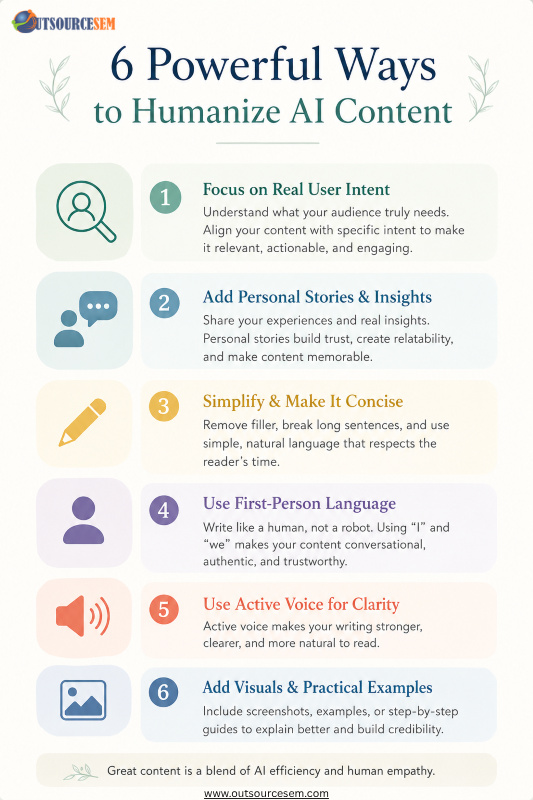
1. Focus on Users' Needs
- The first step towards creating good AI-generated content is finding a way to better understand what the reader wants.
- In most cases, AI solutions produce very generic text. To improve this aspect, you should ensure that your piece corresponds to the actual user intent.
2. Adding Personal Stories And Insights
Using personal experience is one of the best methods of making your text unique.
Here is how you can apply this approach to increase the value of your content:
For Example:
Not "Time management is important."
But "How I managed to stay productive using time management techniques."
By adding this information to the content, you can achieve three things at once:
- Adding some depth to the content.
- Create trust between your message and the audience.
- Increase relatability
This is perhaps one of the most powerful methods for humanizing AI content.
3. Make It Concise and Clear
As a rule, text written by machines will often contain a lot of unnecessary information and long, convoluted sentences.
On the other hand, human-written pieces usually meet the following requirements:
- Conciseness
- Clarity
- Naturalness
Therefore, you should focus on:
- Removing redundant words
- Breaking down long sentences
- Making content clear and understandable
Here is the example:
- Instead of using "To achieve improved productivity, it is important to consider implementing..."
- Use"To improve productivity, start using..."
It would be nice to apply several of those changes to your text and make it easier for your audience.
4. Leverage the Power of First-Person Language
In most cases, content generated by AI will use mostly third-person pronouns (he/she/they). However, it can help your message sound more credible if you switch to the first person.
Instead of "Users can benefit from..." you should write "I find this approach extremely useful for..."
Benefits of this technique include:
- Personality boost
- Building trust
- Making content more engaging for your audience
5. Use Active Voice for Better Readability
One more way of humanizing your content is switching to the active voice.
This type of voice makes your writing more straightforward to understand:
- Passive Voice - "This report was created by our team."
- Active Voice - "Our team created this report."
You can see how this approach can change the whole sentence.
6. Visuals and Practical Examples
Finally, adding visual elements to the text can help you grab readers' attention and make them spend more time on it.
The examples of visual elements include:
- Screenshots
- Images
- Graphs and infographics
- Videos
By including them in your text, you will showcase more credibility and professionalism.
Additional Tip: Use Conversion Tools Carefully
There is plenty of online AI text converters, which may be quite useful to humanize your content.
These tools can do several things:
- Make the tone of your message more natural
- Remove redundancies and repetitions
- Help you adjust the language to the style you need
The problem is that the results of these conversions aren't always ideal. That is why it makes sense to combine:
- Initial AI-generated text
- Conversions with AI-based converters
- Changes done manually
This way, you can get high-quality, relatable content fast.
Common Mistakes While Working With AI Text Converter
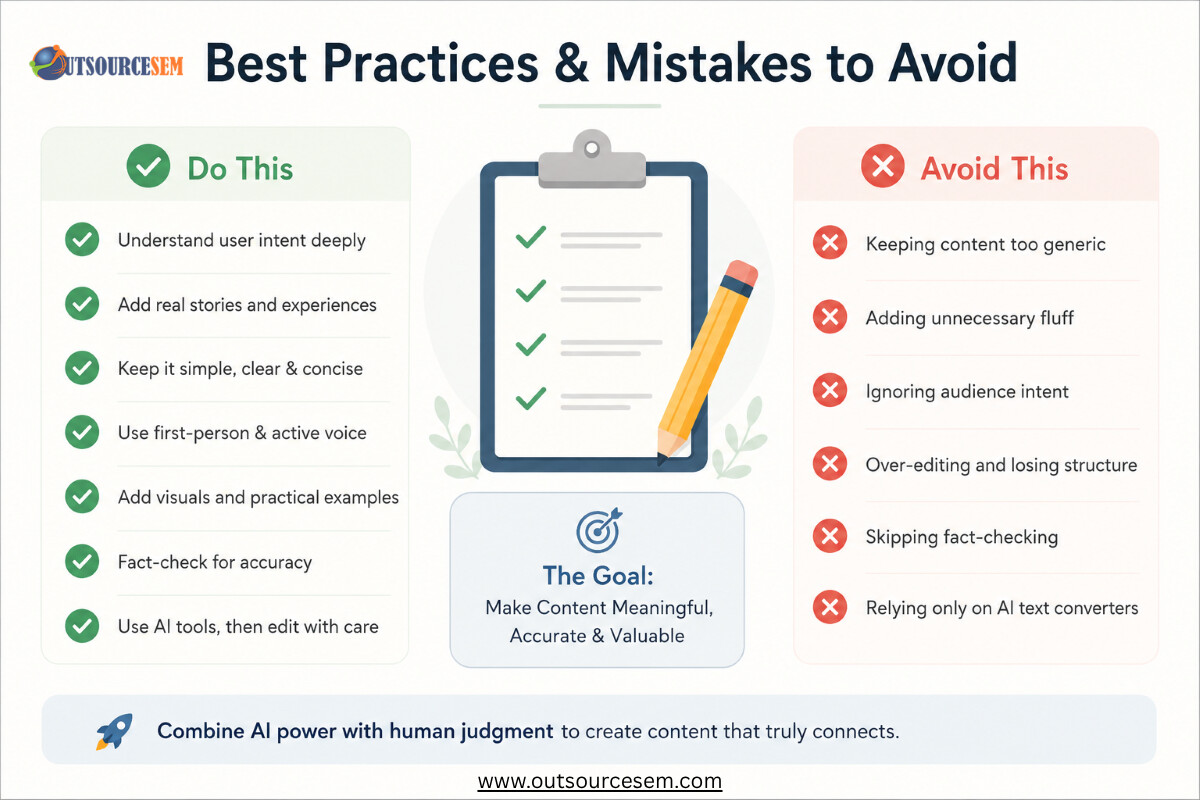
When you convert AI to human text, remember not to:
- Keep text generic and lacking meaning
- Add too much fluff
- Ignore user intent
- Skip fact-checking
Conclusion
Undoubtedly, artificial intelligence has dramatically changed content creation. Now we can scale content generation without spending too much time. However, this solution has one major flaw - the inability to produce relatable, human content.
At OutsourceSEM, we understand this and try to balance AI and human approaches to content generation for maximum efficiency. If you would like to learn more about this aspect of business, feel free to contact us! We're dedicated to elevating your business with top-notch AI-optimized services and innovative strategies.
From PPC reports and PPC audits to running search ads, Facebook ads, video ads, website conversion analysis, backlink analysis, SEO detox & penalty removal, virtual assistant, digital analytics & comprehensive suite of online services covers it all. We'll help you craft effective AI-marketing strategies and generate creative marketing ideas to ensure your business thrives in the age of AI.