
Short Answer
AI influences SEO through enhanced comprehension of intent, sources comparison, complex questions answering, and information presentation. Efficient search optimization involves not only targeting keywords. Websites have to be technically correct, unique, relevant, informative, structured and trustworthy enough to rank in traditional and AI-powered search.
Introduction
Search is no longer done through blue links. Users ask questions through Google AI search, ChatGPT, Gemini, Microsoft Copilot, Perplexity, and many other answer engines.
These changes mean new demands for SEO. A website has to be accessible, indexable, relevant, authoritative, and useful. In addition, it has to be easy to understand and explain to search engines.
Companies need comprehensive coverage of topics, authoritative sources and content showing their experience.
Table of Contents
- Role of AI in SEO
- Changes in search
- Changing SEO strategies
- SEO, AEO and GEO
- How companies should adapt
- Examples, mistakes and FAQs
What Is the Role of AI in SEO?
Artificial intelligence enables search engines to recognize the meaning of search queries, rather than keywords. It allows us to recognize context, relations between entities, comparing sources and finding information.
SEO specialists use AI in keyword clustering, research, technical SEO analysis and routine optimization. This technology helps to analyze large datasets faster and to detect patterns invisible for people.
However, AI cannot substitute human judgment. Tools are unable to understand all aspects of business, its customers, experience, positioning and preferences.
How Is AI Changing Search Behavior?
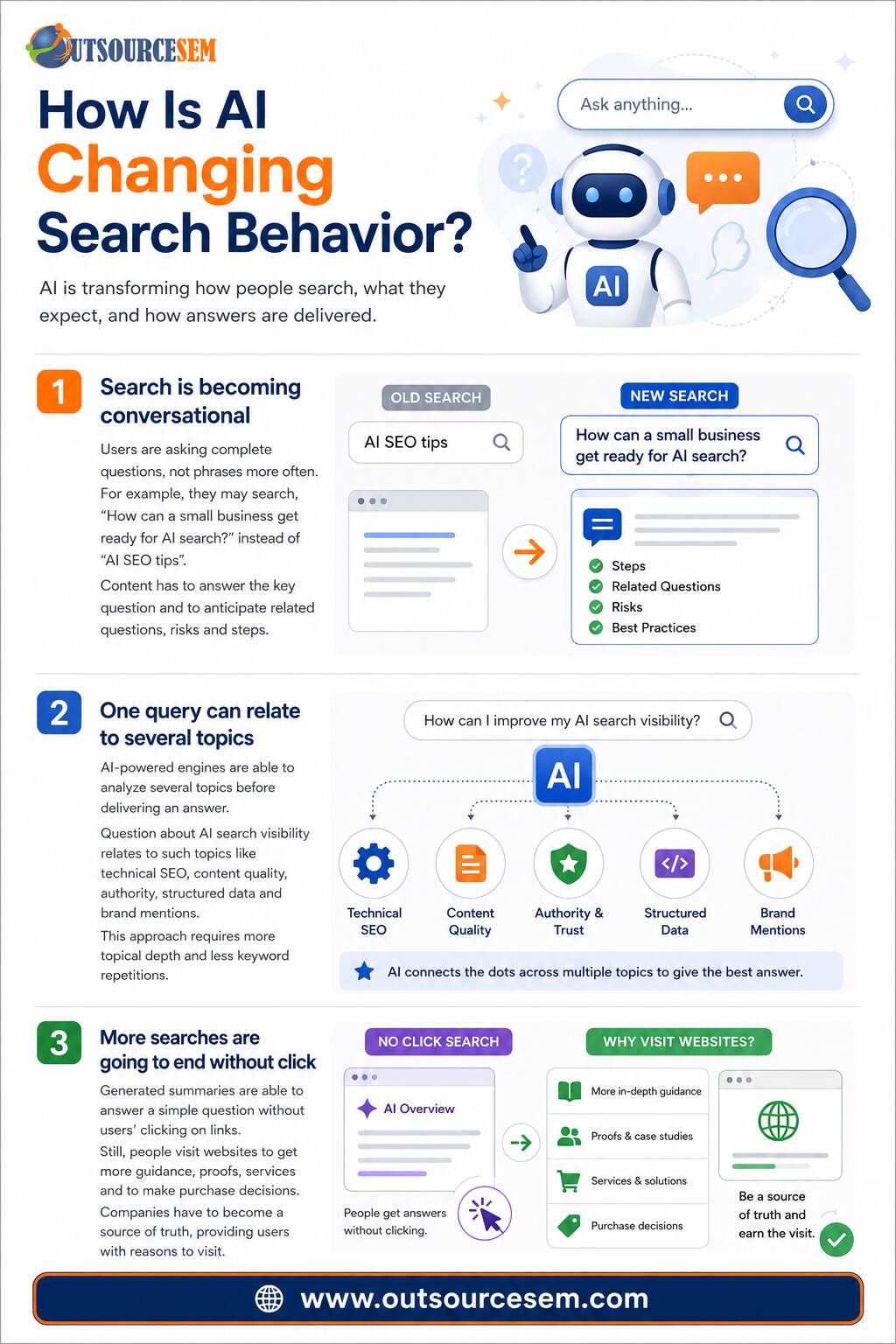
Search is becoming conversational
Users are asking complete questions, not phrases more often. For example, they may search, "How can a small business get ready for AI search?" instead of "AI SEO tips". Content has to answer the key question and to anticipate related questions, risks and steps.
One query can relate to several topics
AI-powered engines are able to analyze several topics before delivering an answer. Question about AI search visibility relates to such topics like technical SEO, content quality, authority, structured data and brand mentions. This approach requires more topical depth and less keyword repetitions.
More searches are going to end without click
Generated summaries are able to answer a simple question without users' clicking on links. Still, people visit websites to get more guidance, proofs, services and to make purchase decisions. Companies have to become a source of truth, providing users with reasons to visit.
How Is AI Changing SEO Strategy?
Keyword research is becoming intent research
Search volume of keywords is still important, but current keyword research includes intent, context, entities, user stage and question type.
Phrases like "AI SEO", "AEO", "GEO", "AI Overviews SEO" may belong to one cluster. Each page has to fulfill a different need, not to target minor variations.
Original value makes the difference
Generic summaries are easier to generate. Valuable content delivers additional explanations, descriptions of processes, and lessons from practice.
Personal experience improves E-E-A-T score by demonstrating deep understanding of topic. Explain what to do, why it is important and when it can be not applicable.
Technical SEO is still crucial
Page cannot perform effectively if it is hard to discover, crawl, render and index. Priorities are:
- Site architecture
- Internal links
- Mobile usability and fast page loading time
- Canonicalization
- XML sitemaps
- Accessible content
- Headings
- Structured data corresponding to page content
Technical SEO remains the basis of any optimization efforts.
Reporting has to move beyond rankings
It is important to track rankings and clicks. But companies should also monitor:
- Mentions in generated answers
- Citations and references
- Branded search volume
- Referral traffic from AI platforms
- Assisted conversions
- Qualified leads and revenue
The main idea is visibility, trust, and commercial success in various search experiences.
SEO, AEO and GEO: what is the difference?
| Discipline | Main Goal | Primary Focus |
|---|---|---|
| SEO | Improving search visibility | Crawling, indexing, relevance, authority, and user experience |
| AEO | Becoming a direct answer | Concise answers and question-based structure |
| GEO | Being included in generated answers | Source quality, entity clarity, evidence, and context |
These approaches complement each other. SEO helps with discovery, AEO with answer extraction and GEO with generated visibility.
How Businesses Should Adapt
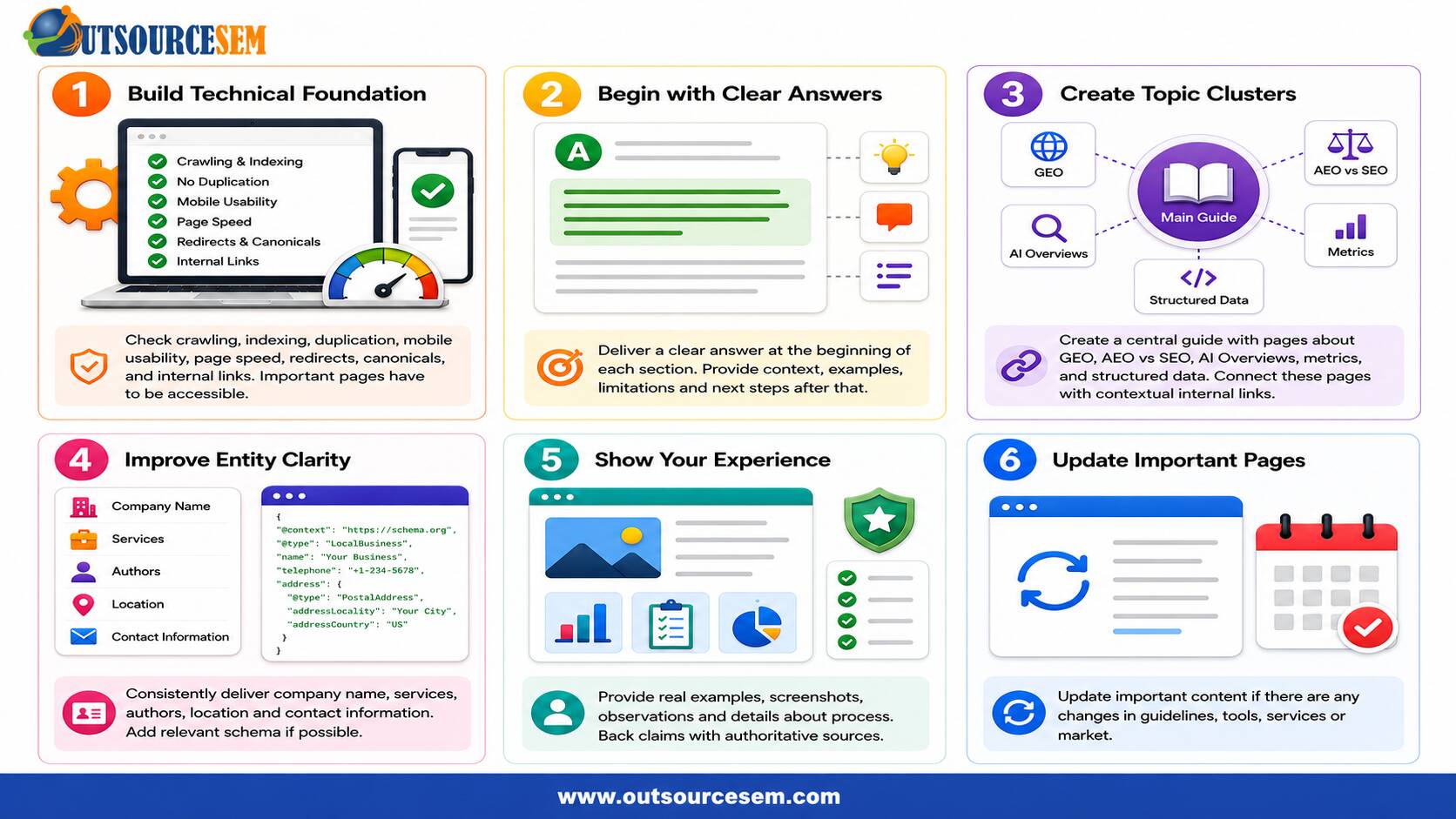
1. Build Technical Foundation
Check crawling, indexing, duplication, mobile usability, page speed, redirects, canonicals, and internal links. Important pages have to be accessible.
2. Begin with Clear Answers
Deliver a clear answer at the beginning of each section. Provide context, examples, limitations and next steps after that.
3. Create Topic Clusters
Create a central guide with pages about GEO, AEO vs SEO, AI Overviews, metrics, and structured data. Connect these pages with contextual internal links.
4. Improve Entity Clarity
Consistently deliver company name, services, authors, location and contact information. Add relevant schema if possible.
5. Show Your Experience
Provide real examples, screenshots, observations and details about the process. Back claims with authoritative sources.
6. Update Important Pages
Update important content if there are any changes in guidelines, tools, services or market.
Practical Example
Take a page "What Is an SEO Audit?"
Poor version offers a definition and generic checklist. Good version answers a question first, explains when audit is necessary, describes process and deliverables, compares types of audits, mentions common problems and provides recommendations for next steps.
Good version helps users to continue their journey and gives additional material to answer different questions.
Expert Tips
- Ensure that each page has one goal.
- Use headers according to user questions.
- Support claims with reliable sources.
- Add examples proving your experience.
- Check automatically generated content for errors and duplicates.
- Measure conversions and revenue, not just traffic.
Common Mistakes to Avoid
Main mistake is producing lots of shallow content. Repetition creates no authority.
Other common mistakes include building pages for minor variations of keywords, citing unsupported statistics, applying irrelevant schema, neglecting technical issues, thinking that AEO or GEO replaces SEO and uncontrolled automation causing polished, but inaccurate or generic content.
Key Takeaways
AI changes the way search engines interpret questions, compare sources and deliver answers. It changes the way users discover brands and make decisions.
Main principles remain the same. Websites have to be accessible, relevant, expert, authoritative and trustworthy. Clear answers, entity clarity, topical depth and advanced measurements matter now more than ever.
Conclusion
AI does not end SEO. It sets a higher bar for useful optimization.
Companies need to go beyond keyword targeting and create technically correct websites, unique content, clear answers, and credible entity signals. They have to measure visibility in traditional and generated search.
Outsource SEM helps agencies and businesses to develop scalable strategies combining technical SEO, content quality, topical authority, AEO, GEO, and performance. Learn more about our SEO outsourcing services.