
Quick Answer: What Changes Is Artificial Intelligence Bringing To Paid Advertising?
With the development of artificial intelligence, the paid media strategy has become more predictive, requiring fewer constant optimizations. Advertising platforms are capable of analyzing numerous signals, estimating how likely certain users will convert, setting bids, matching ads with user intents, and optimizing their delivery based on performance data.
However, what is changing significantly is not the automation itself. It is what advertisers need to optimize.
As more processes become automated, advertisers need to focus on improving the inputs used by these systems: conversion quality, customer data, creative assets, campaign goals, profit targets, and measurement.
Introduction
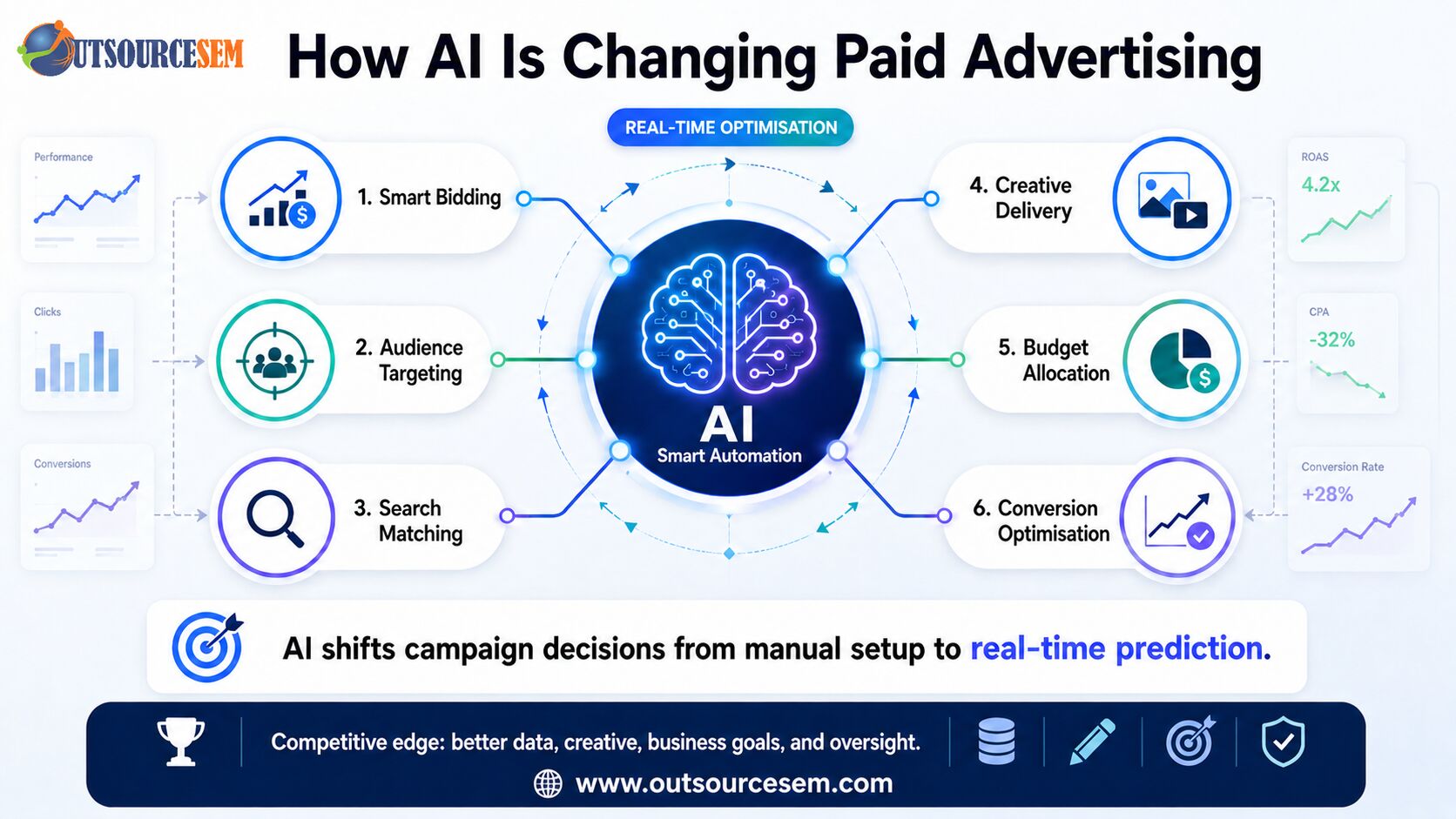
Artificial intelligence is changing paid advertising by replacing many campaign decisions made manually with predictions in real-time. AI can now affect bids, audiences, search matching, creative delivery, budget allocation, and conversion optimization. For advertisers, the competitive advantage is shifting to better data, creative, business goals, and oversight.
Artificial Intelligence Is Changing Paid Advertising From Manual Management to Signal Quality
Traditionally, the knowledge about paid media was directly related to account control. Advertisers were creating complex keyword structures, adjusting bids, dividing audiences, choosing placements, and constantly optimizing their campaigns.
AI is now making some of these manual actions less valuable.
For instance, Google Smart Bidding uses Google's AI to optimize for conversions or conversion value in individual auctions. This system is able to consider contextual signals like device, location, time of the day, language, browser, and other factors before setting bid price.
Meta also follows this general direction with its Advantage+ solution. This feature can help advertisers automate or assist in the process of targeting, placing, budgeting, and delivering campaigns on Facebook and Instagram.
This is how a major change occurs in campaign management.
Advertisers used to have an advantage if they knew how to make a better manual bid adjustment. Now the greater advantage is in telling the system which customers, conversions, and outcomes are truly valuable.
In other words, artificial intelligence makes the signal quality of paid campaign inputs more important than the number of manual changes that marketers can make.
Automated Bidding Is Making Each Ad Auction More Dynamic
Automated bidding is probably one of the most advanced AI implementations in paid advertising now.
Bids made manually usually are based on historical averages. The keyword that performed well last month might be set higher, while the one that became more expensive might get a lower bid price.
The system of AI-powered bids makes decisions individually.
For instance, consider two people that are searching for the same software product. While one of them might be just browsing around to find out more about options available, another person is showing behavior which is strongly connected with high likelihood of purchasing.
A machine learning system can assess available signals and treat these two cases differently.
This makes the key question advertisers have to ask different. They no longer need to think just about "How much should we bid?" But also about "What outcome should the bidding system maximize?".
This can be a completed purchase, qualified lead, revenue, profit, subscription value, or any other result that makes sense for your business.
Now the bid price becomes a machine's decision. However, the goal behind the bid remains a marketer's responsibility.
Artificial Intelligence Is Moving Paid Search Beyond Exact Keywords
Keywords are still important, but AI is changing their role.
Search becomes more detailed and conversational as users start becoming accustomed to AI-powered search experiences. One who used to search for "accounting software" might search now for "accounting software for a small ecommerce business that handles international payments".
This longer search term provides much more context.
Artificial intelligence in advertising can now interpret the meaning behind the search term rather than depend entirely on exact wording. This helps advertisers to reach relevant users even if their search terms do not match a standard list of keywords.
Google AI Max for Search campaign is a good illustration of this direction. This system can use broad match and keywordless technology, along with existing keywords, ads, landing pages, and other data to find relevant searches. According to Google, AI Max is an optimization layer in existing Search campaigns, not a separate campaign type.
What does it mean for advertisers? Just keyword research is no longer enough.
Their campaigns need to have a clear understanding of customer problems, buying intent, product relevance, landing page quality, and messages which are likely to drive a decision.
Artificial Intelligence Is Changing How Paid Campaigns Need to Be Structured
Artificial intelligence is also challenging the old idea of PPC management: that more segmentation means better control.
Accounts traditionally used segmentation by keyword themes, match types, audiences, devices, product categories, funnel stages, and so on. This helped to achieve detailed control but could divide performance data among many small campaigns.
And it is important since machine learning systems need enough signals to detect patterns.
When campaigns with the same objectives are over-segmented, conversion data and budget can become too thin for any effective optimization. As Search Engine Journal writes, campaign structures in the age of AI increasingly need to consolidate enough to preserve conversion density while keeping campaigns separated when it really makes sense.
This does not mean that every account should become a single campaign.
Segmentation makes sense when products require different budgets, profitability targets, geographic strategies, creative needs, or other business goals.
A useful rule is:
Segment campaigns when it is needed for the business. Consolidate them when it is just dividing useful data.
It is a more strategic approach than either of extremes.
Conversion Quality Is Becoming the Fuel for AI Optimization
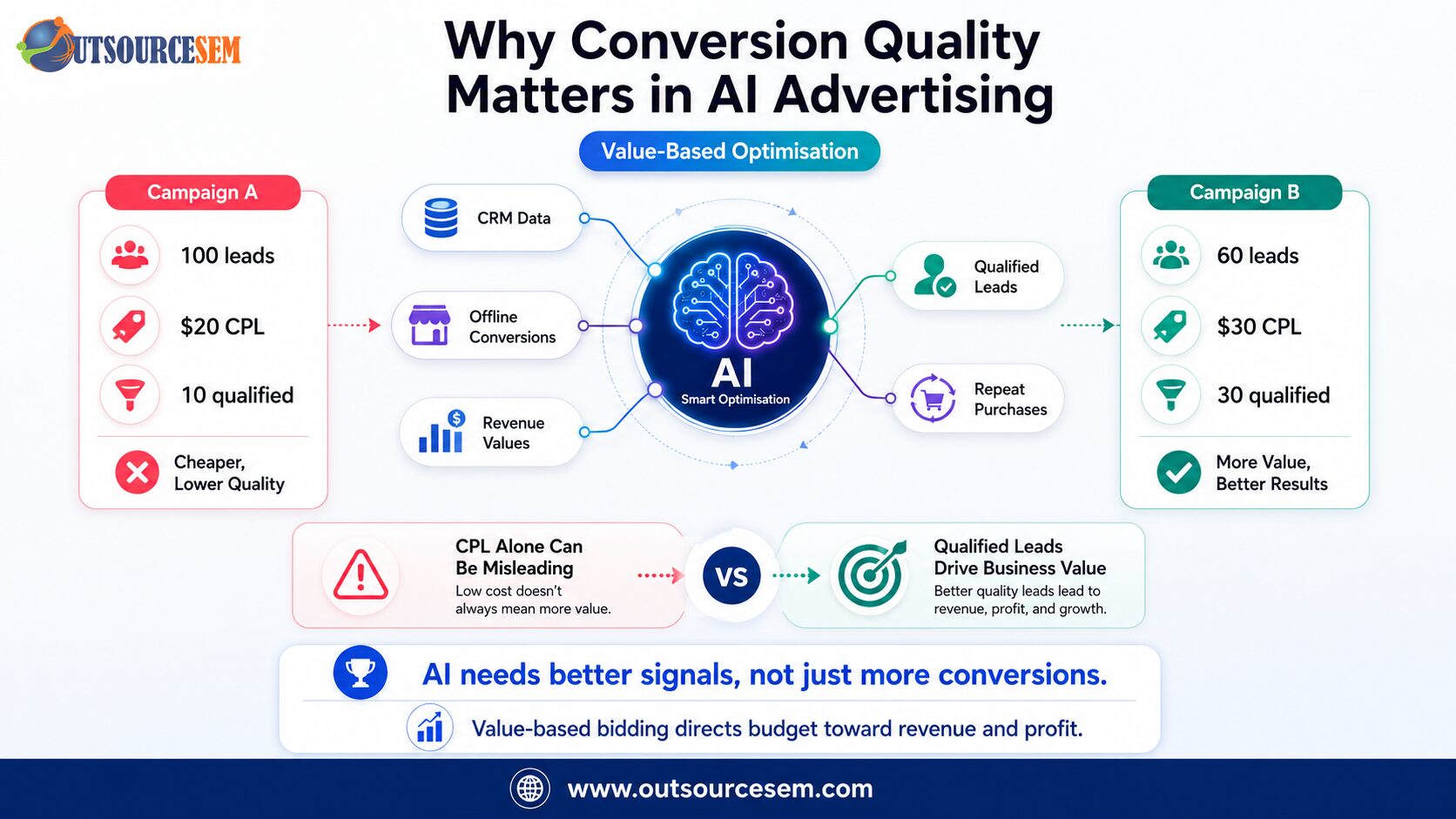
One of the major changes in AI-powered advertising is the growing importance of conversion quality.
Any algorithm optimizes towards the signals it gets. If an advertiser tells the platform that all leads are equally valuable, the system will become very efficient in finding people who complete forms cheaply.
But the problem is that cheap leads are not necessarily profitable ones.
For example, the first campaign generates 100 leads at $20 each, but only 10 of them become qualified opportunities. Another campaign generates 60 leads at $30 each, but 30 of them become qualified.
If optimization is focused just on cost per lead, the first campaign is going to look better.
If the business takes a look at the potential for sales, everything changes.
This is why offline conversions, CRM data, revenue values, qualified lead stages, repeat purchases, and other first-party signals are becoming more and more valuable.
AI does not just need more conversions. It needs a clearer understanding of which conversions are valuable.
And this is why value-based bidding is becoming important. When platforms understand that one conversion is more valuable than another, automated systems are able to direct the budget towards the outcomes which bring revenue or profit rather than just generate activity.
Creative Becomes a More Important Part of Campaign Optimization
Artificial intelligence is also changing the relation between creative assets and performance.
Traditionally, advertisers would create several headlines, descriptions, images, or videos and regularly update them. With generative AI, creating and testing many more variations becomes possible.
Then platforms are able to decide which combination of these assets is more relevant for a particular audience, placement, or moment.
Both of Google's AI-driven advertising products work in such a way. Performance Max uses AI in areas including bidding, creative, audiences, budget optimization, and cross-channel delivery, while Meta Advantage+ sales campaigns automate creative, targeting, placement, and budget decisions. Meta reports that advertisers using Advantage+ sales campaigns experience average 9% improvement in cost per conversion, although individual performance varies.
Google also states that advertisers using AI Max with all its Search features saw an average 7% increase in conversions or conversion value at a comparable CPA or ROAS compared with search-term matching only. The number comes from Google's internal data, so it can be seen as an indication of potential, rather than a guarantee of results.
What does it mean strategically? It is not just about generating more creativity.
It is about providing the AI with different creative options.
Ten headlines which tell the same generic benefit are less valuable in terms of testing than several different headlines, addressing various customer problems, objections, benefits, and motivations.
AI is helping with accelerating the creative production process. Marketers still need to generate the ideas worth testing.
Continuous Optimization Is Possible
Artificial Intelligence has also improved how quickly paid campaigns can adapt to new data.
Traditionally, the process of optimization had been schedule-based. A specialist looked into the account, found problems, changed bids and budgets, updated ads and came back to check the effects.
Machine-learning algorithms can optimize the campaigns continuously.
Bids can be changed between auctions. Budgets can be redirected to better opportunities. Creatives with better performance can be prioritized. Audience expansion can happen when a machine learns that people outside initial target criteria would bring better results.
For instance, the Advantage+ Campaign Budget of Meta reallocates budget among ad sets in real time, depending on opportunities discovered by its algorithm.
The problem of continuous optimization is that platform improvement does not equal business improvement.
A platform can improve Cost Per Acquisition metrics while average customer value falls. It can increase the number of leads while the sales department receives fewer qualified leads.
Advertisers, thus, need to connect the platform data with the actual business data. Revenue, margin, lead quality, customer acquisition cost, lifetime value and incremental growth matter along with CTR, CPC, CPA and ROAS.
AI Search Changes the Paid Ads' Environment
It is not only advertising platforms that are being changed by artificial intelligence. The environment of advertisements is also evolving.
Search engines use AI to provide answers, recommendations, comparisons, summaries and other types of useful content right within search results.
And this can influence the user's choice before he clicks on an ad.
Recently, Search Engine Land reported about the situations when Google AI's Overviews and ads were showing different recommendations on the same search results page.
That's the new reality for paid search marketers.
To win an ad auction does not automatically mean winning the user's attention and consideration. The customer can see an advertisement next to organic search results, reviews, recommendations generated by AI, videos, shopping results and many other pieces of brand presence.
Paid advertising results, thus, get increasingly related to SEO, reputation management, content quality, reviews and brand authority.
Campaign optimization becomes impossible to do within the limits of advertising platforms.
Step-by-Step Guide on Optimizing AI-Powered Campaigns
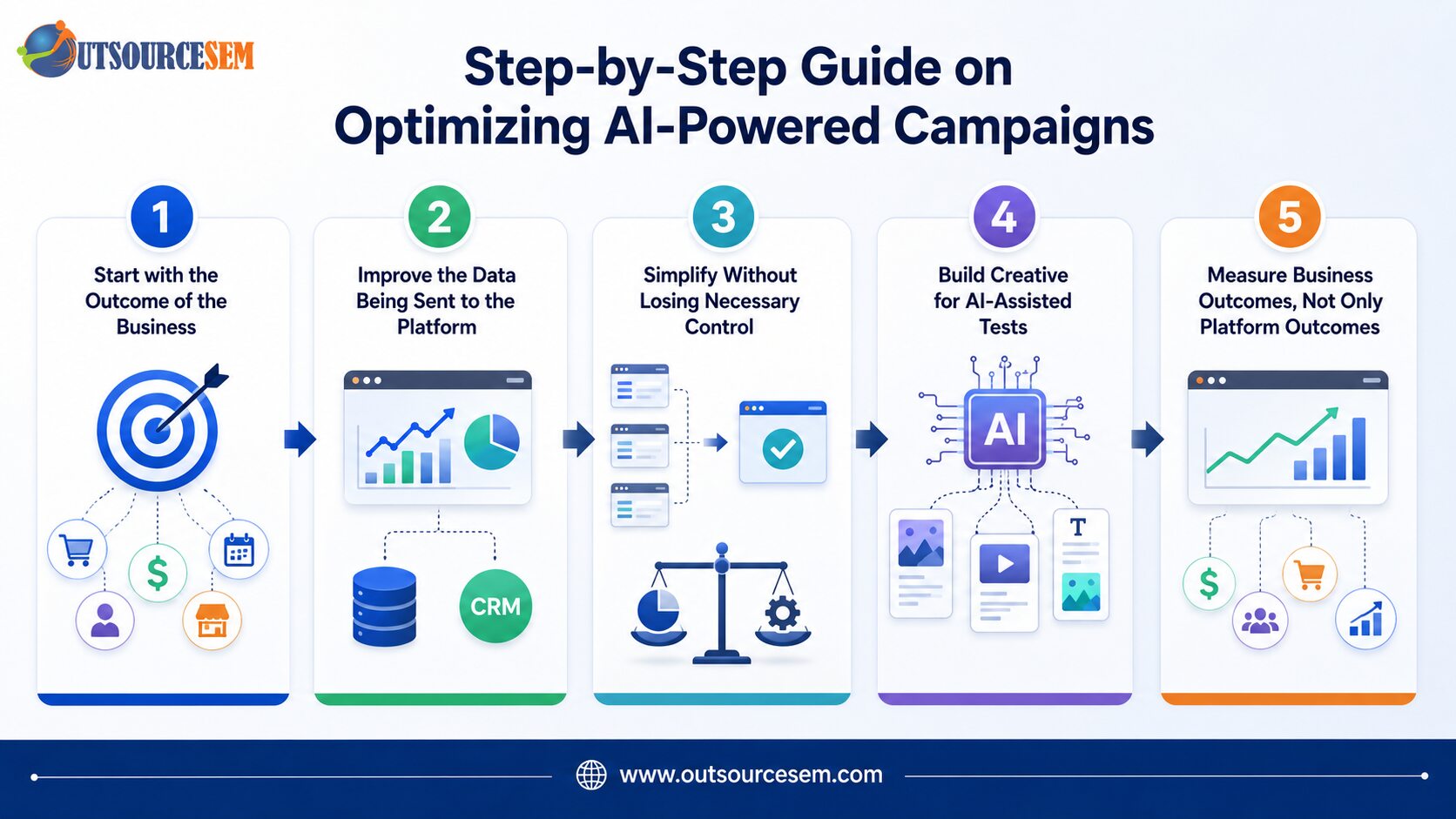
1. Start with the Outcome of the Business
Define the outcome that really delivers the value and choose a bidding strategy. The leads, sales, bookings, subscriptions and visits to stores have to be used as optimization goals only when they reflect the business objective.
2. Improve the Data Being Sent to the Platform
Make sure that conversion tracking is properly done and that the data from the advertising platform is linked to CRM or revenue. Assign bigger signals to high-value conversions.
3. Simplify Without Losing Necessity of Control
Evaluate if the campaign segmentation makes sense. Unify campaigns where segregation brings nothing else than fragmentation of budget and conversion data. But leave it when margins, markets, objectives or any other requirements are different.
4. Build Creative for AI-Assisted Tests
Provide really different messages, instead of using dozens of similar variations. Test benefits, proof points, objections, use cases, offers and positioning.
5. Measure Business Outcomes, Not Only Platform Outcomes
Determine if automation helps to achieve better revenue, profitability, lead quality or customer value.
Common Mistakes in AI-Powered Paid Advertising
The biggest mistake is believing that AI can compensate for weak strategies.
Poor conversion tracking, non-competitive offer, confusing landing page, poor creative and wrong campaign objective cannot be fixed through automation.
Another mistake is handing over the control completely, since the platform suggests doing it. AI needs some room to learn, but advertisers should set proper exclusions, brand guidelines, budget controls, measurements and performance reviews.
The goal should never be to automate everything.
The goal is to automate those decisions that are made perfectly by machines and leave to humans those that require business decisions.
Key Takeaways
AI is moving paid advertising from manual control to signal-driven optimization.
Conversion quality, first-party data and creative strategy are becoming more important.
Campaign structure should balance machine learning and necessary business controls.
Marketer's role is moving from settings management to strategy, inputs, measurements and profitability management.
Conclusion
AI is changing paid advertising and campaign optimization through transferring more of the process of campaign execution to systems capable of evaluating signals, predicting outcomes and making decisions in real time.
However, the competitive advantage in the long term is not going to come from just activating more AI features. It will come from providing these systems with better information: accurate conversion signals, valuable customer data, differentiated creative, realistic business objectives and reliable measurement.
With more and more processes transferred to AI, marketers need to become better strategists, instead of becoming more actively involved in campaign management.
The future of paid advertising belongs to businesses that understand this principle: AI may handle more of the campaign process, but humans still define what advertising success looks like.