
Quick Answer
In digital marketing, predictive analytics uses AI and machine learning to predict what a customer is going to do next. It does not only show the past behavior of the customer but helps calculate probabilities of his/her future actions like purchasing something, leaving, responding to a marketing campaign, etc.
Introduction
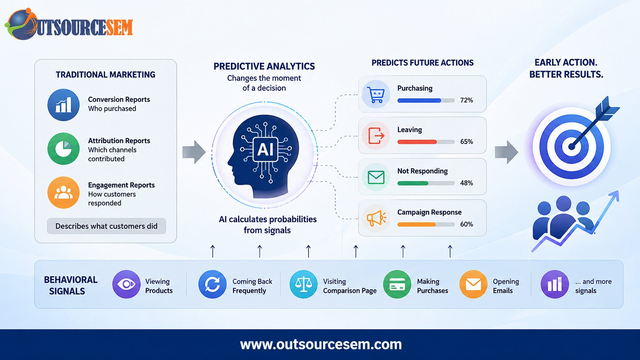
Traditionally, digital marketing has used historical data about clients' behavior. Reports of conversion show who purchased something, reports of attribution help determine which marketing channels contributed to a purchase, and engagement reports demonstrate how customers responded to a marketing campaign. Useful as it may be, the information is describing what customers did.
Predictive analytics changes the moment of a decision.
Instead of waiting till the customer has done something, marketers can use AI to calculate probabilities of different actions, including purchasing, leaving, not responding to the campaign, and so on. For example, a model can detect that a customer who purchases something every 30 days has not ordered for 50 days and opens fewer emails. These signs together could mean that there is a possibility that the customer is going to leave soon.
The same principle applies to the purchase intention. Viewing products, coming back frequently, visiting a comparison page, making purchases, opening emails, all these signals together could mean that a customer is ready to buy something.
The main thing is that AI does not read customers' minds. It calculates probabilities based on the signals.
What Is Predictive Analytics in Digital Marketing?
Predictive analytics in digital marketing is a set of statistical techniques and machine learning models based on historical customer data and behavioral signals to predict the future actions of customers.
Usually, the outcome of predictive analytics includes probabilities, values, rankings, or classifications.
For instance, instead of creating an audience "visitors who visited a product page", a company can develop a model that predicts which customers are likely to purchase a product in the following seven days.
The difference is important.
Two customers could visit the same product page but have different levels of intention to buy the product. One may be just a new visitor who came through an informational search, while another customer may visit the page several times, compare products, open promotional emails, check the delivery, and so on.
A marketing system based on the rule may treat these two customers identically, but a predictive model could evaluate the full context and assign different probabilities of purchasing to them.
How AI Forecast the Behavior of Customers
Firstly, AI forecasting requires the definition of an outcome.
Suppose, an ecommerce company is interested in predicting purchase in the following seven days. The company will need historical examples of customers who purchased in seven days and customers who did not.
Then, the model analyzes variables that existed before these outcomes occurred.
They could be the number of days from the last visit, number of sessions in the last 30 days, visited products, purchasing frequency, average order value, email engagement, adding products to the basket, applying any discount, and so on.
Machine learning detects the relationships between the variables and the final outcome.
For example, the historical data could show that customers who visited the same product several times in 48 hours, compared different alternatives, and checked the delivery usually bought the product.
When a customer shows the similar behavior, the model assigns him/her higher purchase probability.
In general, the whole process could be described in the following way:
Customer's activity → Predictive features → Pattern recognition → Probability score → Marketing decision → Measured outcome
When a prediction changes the decision of a marketer, the model becomes valuable.
Behavioral Signals Are More Useful in Combinations
One of the most useful advantages of predictive analytics is that it is able to evaluate a combination of customer signals.
For example, take recency.
If a customer visits a website yesterday, it could mean that he/she is interested in purchasing. However, recency becomes more important when it is analyzed together with frequency and direction.
Suppose, Customer A visited the website once this month, and it happened yesterday. At the same time, Customer B visited it once a month, but during the last seven days, Customer B visited it five times and viewed the same category of products.
Customer B's acceleration in activity could be a more powerful signal.
That is why useful predictive models often create such features as 7-day session frequency, days since the last order, change in purchase interval, 30-day category views, average order value, or engagement trend instead of using only raw events.
Sometimes the change in behavior is more important than the behavior itself.
Purchase Propensity Modeling: Predicting Who Is Going to Buy Something
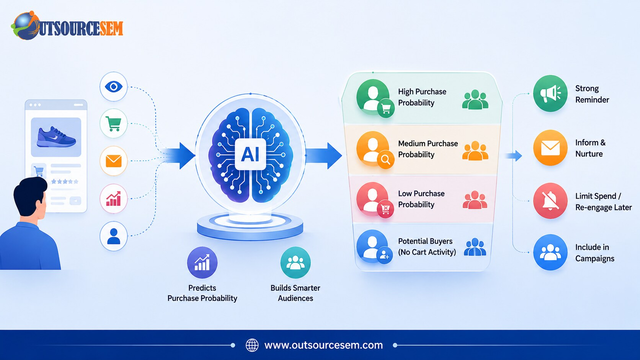
Purchase propensity modeling is aimed at estimating the probability of a purchase within a defined period of time.
Google Analytics provides a good example of this practice because it offers predictive metrics and predictive audiences. For some properties, it is able to calculate metrics related to purchase probability and use the predictive audience based on the expected future behavior.
For marketers, propensity modeling allows improving construction of the remarketing audience.
Traditional remarketing may target all customers who abandoned a cart, but abandoning a cart does not necessarily mean the same purchase intention.
Some customers may add products to compare their prices, and other customers may be ready to purchase something.
At the same time, there could be a customer who never added any products to the cart but is likely to purchase something if his/her behavior is similar to the behavior of historical buyers.
Instead of using one event to construct targeting rules, propensity models could take these differences into account.
Churn Prediction: Identifying Customers Who May Stop Engaging Soon
Churn prediction is the opposite process. Instead of detecting increasing purchase intention, a model looks for signals associated with customers who were inactive, stopped purchasing or cancelling.
The most useful sign is not always the low engagement. It could be a decline in engagement unusual for this particular customer.
Suppose, there are two subscribers who log in to the site twice a week.
For the first subscriber, it could be the usual frequency of logins, and for the second one, this could be a significant decrease.
A churn model takes it into account.
Other useful signals could be increasing time between purchases, decreasing feature usage, email engagement, failed payments, session frequency, or customer-service interactions.
It means that a company gets the opportunity to intervene in the process before the client has left completely.
Predicting Customer Lifetime Value
Not every conversion is equal to the same value.
For example, there could be two customers who make a first order worth ₹5,000 each. For these two customers, the value will be equal.
However, in the future, they could show a different behavior. Historical data could show that customers who behave like the first one usually do not come again, but customers like the second one purchase regularly, explore additional categories, and stay active for several years.
Predictive customer lifetime value tries to calculate the difference in the future economic value.
That prediction influences the decisions about acquisition. A company can rationally invest more money into acquisition of an audience which is likely to bring more profit in the future.
It also influences the strategies of retention and loyalty. Instead of finding customers who will convert now, it helps understand which customers are able to create long-term value.
Prediction and Next Best Action
A common misconception is that a prediction automatically tells marketers what to do.
It does not.
Suppose, the model detected a customer who has extremely high purchase probability. The obvious reaction would be to send this customer a discount.
However, a customer might buy without any discounts. In this case, the prediction would be correct, but the marketing decision would make a profit lower than it could be.
The better approach is separation of the prediction and an intervention.
A customer with high purchase probability could get a product reminder, and a customer with medium probability could get additional information about the product.
Then, marketers would test these actions against the control group.
That introduces an important difference. Predictive modeling asks who is likely to do something, and incremental measurement asks whose behavior has changed because of the marketing campaign.
Practical Example
Suppose, there is an online retailer which has 100,000 active customers.
Instead of sending the same promotion to the whole database, the company builds a seven-day purchase propensity model using the appropriate first-party data.
The model analyzes purchase recency, order frequency, recent category views, return visits, email engagement, adding products to the basket, and response to promotions.
It identifies 10,000 customers with relatively high purchase probability, 30,000 with medium purchase probability, and 60,000 customers with low purchase probability.
The company does not start to send discounts to the top 10,000 right away.
It creates test and control groups. Some high-purchase probability customers receive product reminders without discounts. Some medium-probability customers get other incentives or messages. Control groups receive no extra intervention.
The retailer evaluates incremental conversions and profit instead of just looking at the campaign's conversion rate.
In this way, it answers a much more valuable question than “Did high-purchase probability customers buy?”
It asks, “Did using the prediction improve the marketing outcome?”
Prediction vs Segmentation in Digital Marketing
Segmentation of clients in the traditional sense is usually based either on attributes or behavior. Examples of such segmentations are customers who made a purchase within six months, visitors from a specific channel or users who opened a particular category.
Predictive segmentation is based on expected behavior in the future.
For example, instead of "customers who purchased twice" the audience might become "customers with high probability of making a purchase within seven days".
And instead of "customers who have not logged in recently" it might become "active customers whose behavior pattern shows growing churn risk".
Both types of segmentation are still relevant, but the predictive one is able to adjust for any changes that could have been missed by fixed rules.
Privacy and Quality of Data Are Indispensable in Prediction
First of all, data has to be reliable.
If events are missing, duplicates exist, identifiers are not unique, transaction records are false or analytics configuration is wrong - the model will pick up irrelevant patterns.
Secondly, privacy is crucial here too.
Companies must use customer data in compliance with respective regulations, as well as with their own data practices related to consent, purpose, retention, data minimization and others.
Collecting more customer information just because it can be processed by an AI model is a bad approach.
Also, marketers have to ask themselves whether a particular model uses some kind of unfair bias or inappropriate proxies.
Even a technically accurate model can result in poor business decisions if it uses customer data inappropriately.
Why Predictive Models Become Less Accurate in the Course of Time
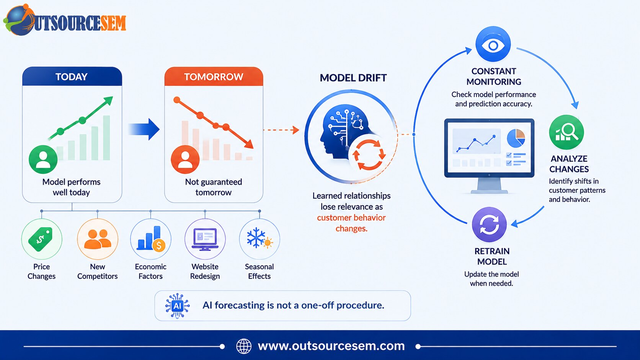
A predictive model that performs good today is not guaranteed to show equal performance tomorrow.
Because customer behavior changes.
A change in price can impact the purchase pattern. New competitors can shift customers' consideration behavior. Economic factors can influence spending. Website redesign can change the meaning of engagement. Seasonal effects can temporarily increase the purchase frequency.
And that causes a model drift, when relations that were learned by a model in the course of time lose the relevance for the current customer behavior.
Predictive marketing, hence, requires constant monitoring. It is necessary to analyze whether predictions are still accurate, whether some customer patterns have changed and whether the model requires retraining.
AI forecasting is not a one-off procedure.
Common Mistakes in Predictive Marketing
Firstly, treating a predicted probability as a certainty.
Even if the model predicts a high propensity score, the customer can still choose not to make a purchase.
Secondly, confounding prediction with causation.
For example, if customers who read five reviews tend to make purchases often, it does not mean that reading five reviews is the reason for the purchase. Both behaviors may correlate with some common factor, such as high purchase intent.
The third mistake is maximizing only for the model accuracy.
Even the most sophisticated model would not be very valuable if marketers cannot translate its results into decisions.
And finally, it is not correct to assume that each high-value prediction requires more marketing. Sometimes it is even needed to reduce the marketing efforts to save an unnecessary ad budget or not to incentivize customers who are already ready to convert.
Key Takeaways
Predictive analytics allows digital marketers to estimate future customer behavior rather than use only historical reporting.
Its main use cases are purchase propensity, churn prediction, predictive customer lifetime value and next best action. But predictive marketing requires more than an AI model itself. Companies require quality first party data, clear goals, appropriate privacy management, model monitoring and experiments which prove whether marketing actions actually change customer behavior.
Here is the framework:
Data -> Prediction -> Decision -> Experiment -> Business impact
Conclusion
Creating a Predictive analytics model in digital marketing transforms customer data from history of past behavior to instruments for predicting future decisions. With the help of AI models patterns of purchase, disengagement, customer value and shifting intent can be found even before those outcomes can be reported.
However, accurate forecasting is only a part of the game. Its real value is in connection of each prediction with an appropriate action, experiment to prove that action changes behavior, protection of customer data and continuous validation of the model.
That is a difference between predicting customers and using predictive analytics to make better decisions.